Apple Q4 2026 Earnings: Services Hit All-Time Record, iPhone Surges 17%
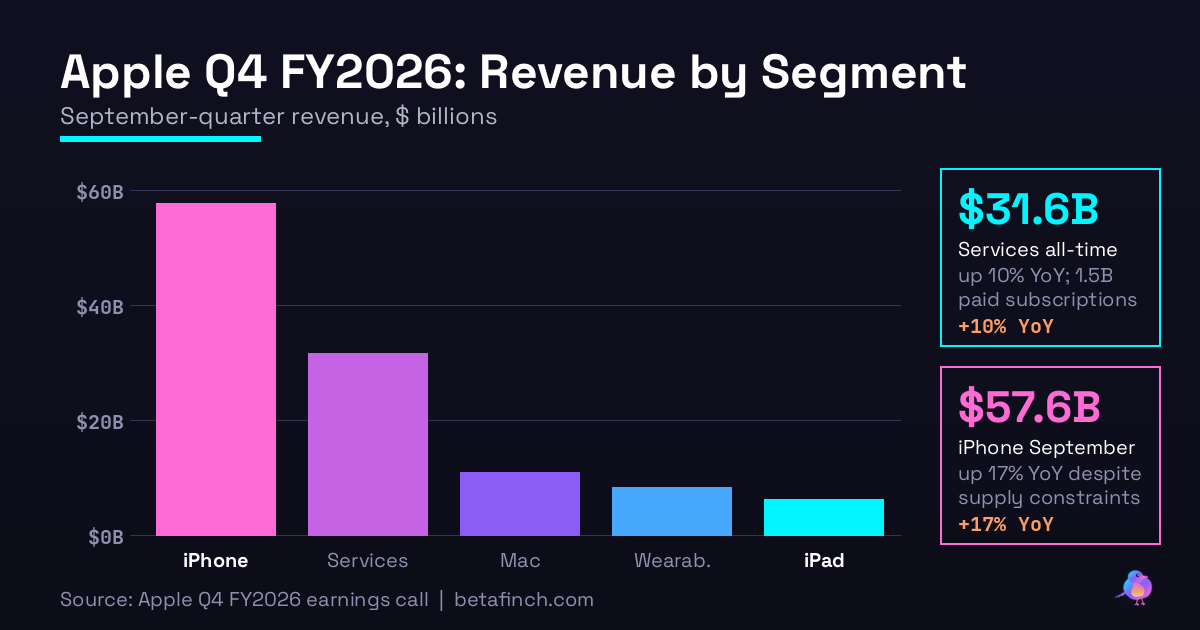
Apple (AAPL) reported fiscal fourth-quarter 2026 revenue of $114.5 billion, up 12% year over year and a new September-quarter record. The result was anchored by two headline drivers: iPhone revenue of $57.6 billion, up 17% year over year, and Services revenue of $31.6 billion, an all-time high for the segment. Diluted earnings per share grew 14% year over year to $2.10, as operating leverage amplified the revenue gains across the income statement.
Key Numbers
Revenue: $114.5B
EPS: $2.10
Revenue Growth: +12%
iPhone Drives a September-Quarter Revenue Record
iPhone revenue of $57.6 billion represented the strongest September-quarter result in the product's history, rising 17% year over year despite supply constraints and foreign exchange headwinds that management acknowledged on the earnings call. The iPhone 17 lineup's on-device AI capabilities drove elevated demand in the premium tier, with carriers reporting higher trade-in activity compared to the prior comparable period. The timing of the Apple Intelligence rollout, which expanded to additional languages and markets throughout the September quarter, extended the period of heightened replacement demand beyond what Apple saw in the comparable period of fiscal 2025. Apple's active installed base of 2.5 billion devices globally provides a persistent replacement-demand signal; even modest shifts in the annual device refresh rate across a base of this scale translate into significant unit volume movements.
Services Reach an All-Time High
Services revenue reached $31.6 billion in the quarter, up 10% year over year and an all-time record across all geographies and product categories. The result reflects the compounding benefit of monetizing a 2.5 billion device installed base through digital services that exhibit high renewal rates and low marginal distribution cost. Paid subscriptions surpassed 1.5 billion, growing double digits year over year, with new geographic records set across multiple regions including markets where Apple's services penetration has historically trailed device penetration. The subscription count's double-digit growth rate is notable given the absolute base; adding subscriptions at scale requires continued expansion into lower average revenue per user geographies, which Apple has pursued through localized pricing and regional App Store content initiatives. The App Store, Apple TV+, Apple Music, iCloud+, and AppleCare collectively anchor the segment, each benefiting from the network effects of a large, high-engagement device ecosystem. Services revenue now represents roughly 27.6% of total quarterly revenue, illustrating a structural shift in Apple's mix away from pure hardware cyclicality.
Mac, iPad, and Wearables
Mac revenue was $10.8 billion, up 24% year over year despite supply constraints tied to the ramp of next-generation silicon. The result reflected a combination of pent-up enterprise demand and consumer adoption of the M4-class chip family, which delivered meaningful performance-per-watt gains over prior generations. iPad revenue was $6.2 billion for the September quarter, as the product line approached its next refresh cycle. Wearables, Home and Accessories revenue was $8.3 billion; the segment absorbed a later AirPods product cadence relative to the prior year, though Apple Watch unit trends remained stable across the quarter.
Gross Margin and Record Operating Cash Flow
Gross margin for the quarter was 47.9%, with tariffs providing approximately 1 percentage point of benefit. That tailwind offset memory-pricing pressure that weighed on hardware margins across the iPhone and Mac product lines; NAND and DRAM spot prices remained elevated through much of the quarter, compressing per-unit economics on storage-intensive configurations. Operating cash flow was $28.1 billion for the quarter, a September-period record, reflecting strong net income conversion and disciplined working-capital management. Apple continued its capital return program through share repurchases and a quarterly dividend, both funded by operating cash generation without recourse to external financing.
Apple Intelligence and the Product Roadmap
Apple's fiscal 2026 product strategy centered on two threads: expanding Apple Intelligence across the installed base and refreshing hardware around the A20 Pro chip. The Siri AI relaunch introduced context-aware responses and cross-app automation, features Apple cited as a differentiator in the premium smartphone segment and a catalyst for replacement demand among the existing device base. The iPhone Duo foldable, launched in select markets near the end of the fiscal year, expanded Apple's form-factor range and introduced a price tier above the standard iPhone Pro Max, addressing a category previously occupied primarily by Android manufacturers. Mac Touch added touchscreen functionality to select MacBook Pro configurations, closing a gap relative to Windows competitors in the premium portable segment. The A20 Pro chip, manufactured on a 2nm-class process, enables new on-device inference workloads without additional memory bandwidth constraints, a technical foundation that underpins the scalability of Apple Intelligence features across the full device range.
December-Quarter Guidance
For the December quarter, Apple guided revenue growth of approximately 7-10% year over year. The guidance range reflects continued iPhone 17 demand into the holiday season, the initial commercial ramp of the iPhone Duo foldable, and Services growth tracking consistent with the double-digit subscription trajectory established through fiscal 2026. At the midpoint of the guidance range, December-quarter revenue would approach the $124-127 billion range, which would represent another holiday-period record. The 1.5 billion paid subscriptions figure provides a relatively stable revenue floor for the Services segment, as subscription retention at this scale tends to generate predictable quarter-to-quarter renewal volumes independent of hardware cycles. December-quarter guidance of 7-10% also implies that the Services share of total revenue will continue to tick upward, as subscription renewal volumes are front-weighted in the holiday quarter while hardware units face tougher year-over-year comparables from the prior iPhone launch cadence.
Key Figures from the Quarter
- Q4 fiscal 2026 revenue: $114.5 billion, up 12% year over year, a September-quarter record
- iPhone revenue: $57.6 billion, up 17% year over year
- Services revenue: $31.6 billion, an all-time record for the segment
- Mac revenue: $10.8 billion, up 24% year over year
- iPad revenue: $6.2 billion; Wearables, Home and Accessories: $8.3 billion
- Diluted EPS: $2.10, up 14% year over year
- Gross margin: 47.9%, with approximately 1 percentage point of tariff benefit
- Operating cash flow: $28.1 billion, a September-period record
- Active device installed base: 2.5 billion; paid subscriptions: 1.5 billion, growing double digits
- December-quarter revenue growth guidance: approximately 7-10%
For a full breakdown of the earnings call, including management commentary on geographic performance by segment, the AI hardware roadmap timeline, and capital allocation priorities, the Beta Finch Apple earnings podcast covers each segment in detail at /podcasts/aapl.