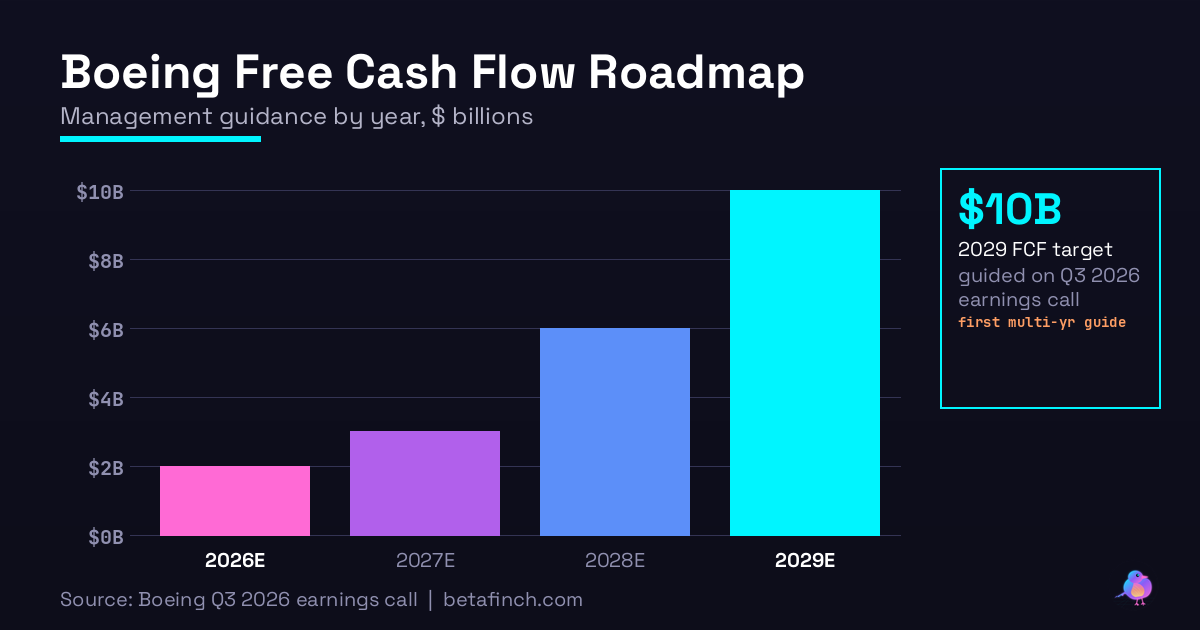
Boeing Q3 2026 Earnings: Record Backlog and Path to $10B Free Cash Flow
Boeing delivered 161 commercial aircraft in Q3 2026, the most since 2018, as a $745B record backlog and a multi-year FCF roadmap to $10B by 2029 define the recovery arc.
Earnings analysis, sector roundups, and guides for following quarterly earnings.
Boeing delivered 161 commercial aircraft in Q3 2026, the most since 2018, as a $745B record backlog and a multi-year FCF roadmap to $10B by 2029 define the recovery arc.
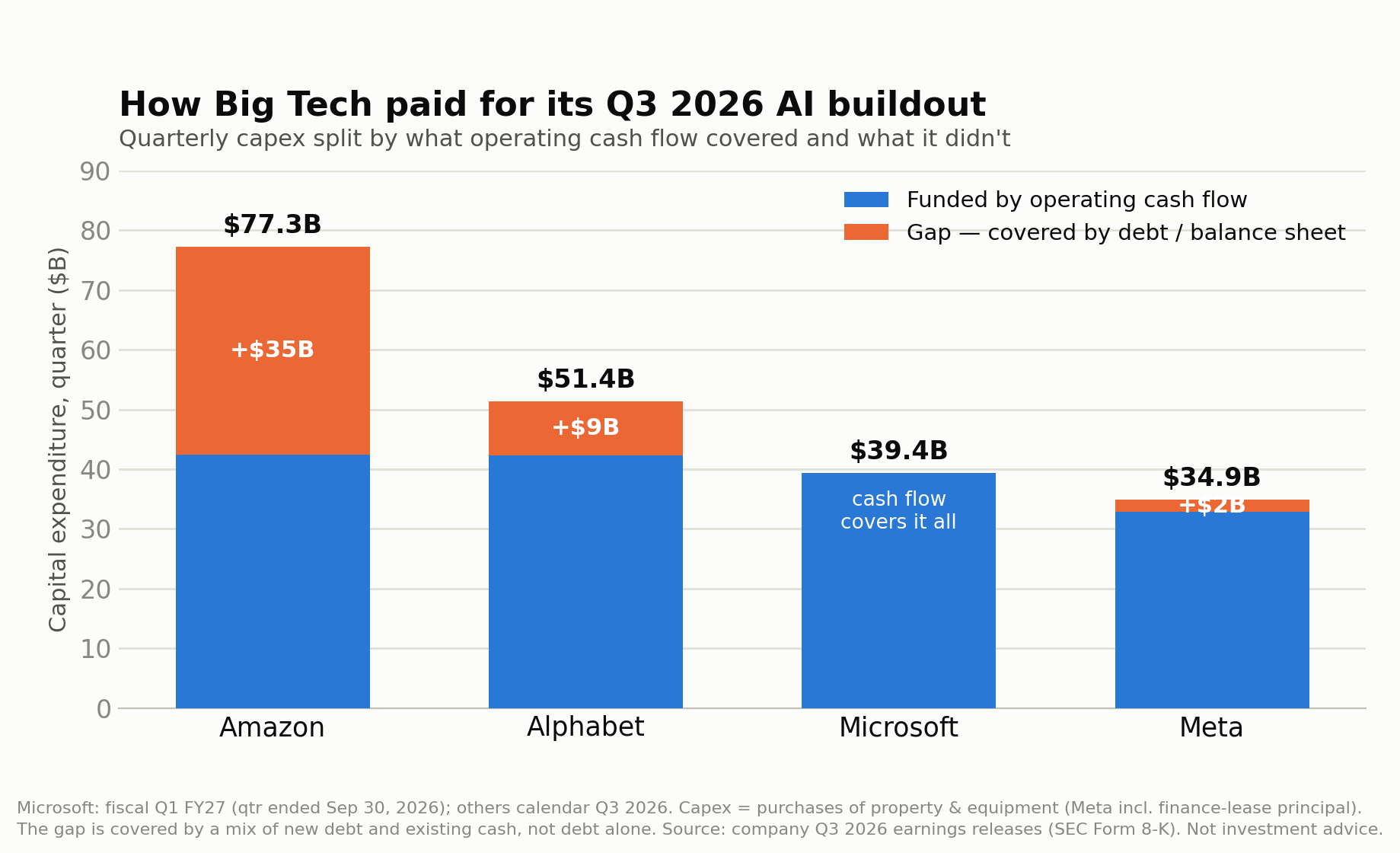
The four largest hyperscalers spent more than $200 billion on capex in Q3 2026, and three of them spent more than they generated in operating cash. Our first quarterly ledger of AI spending, debt and compute commitments.
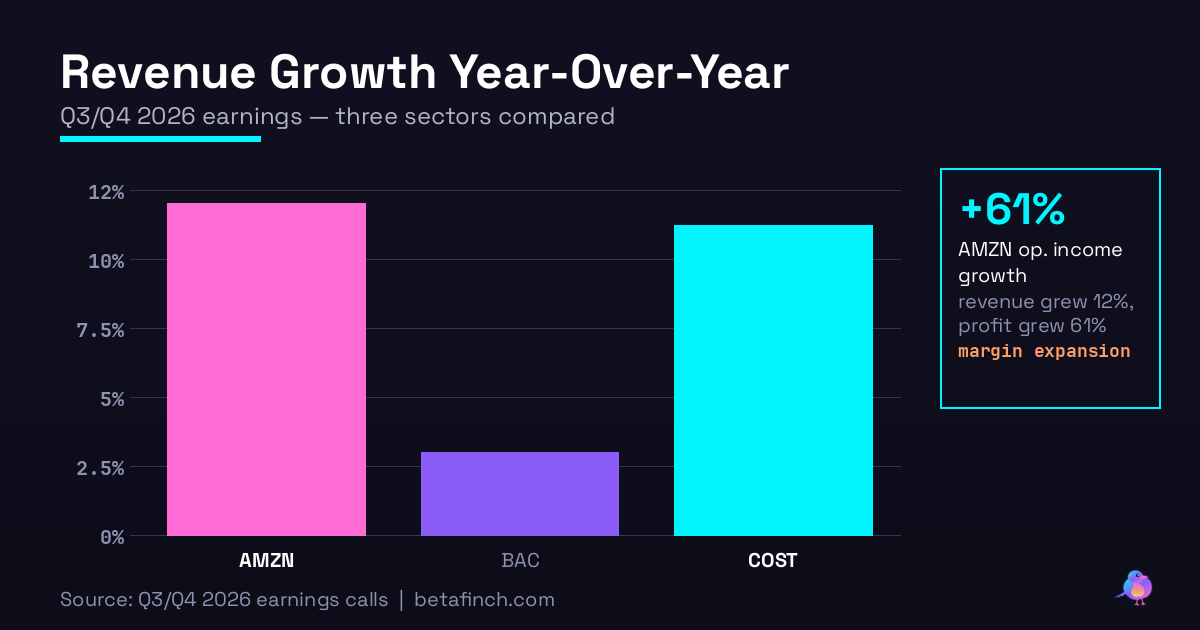
Five concrete skills for extracting signal from earnings transcripts, illustrated with Amazon, Bank of America, and Costco Q3/Q4 2026 results.
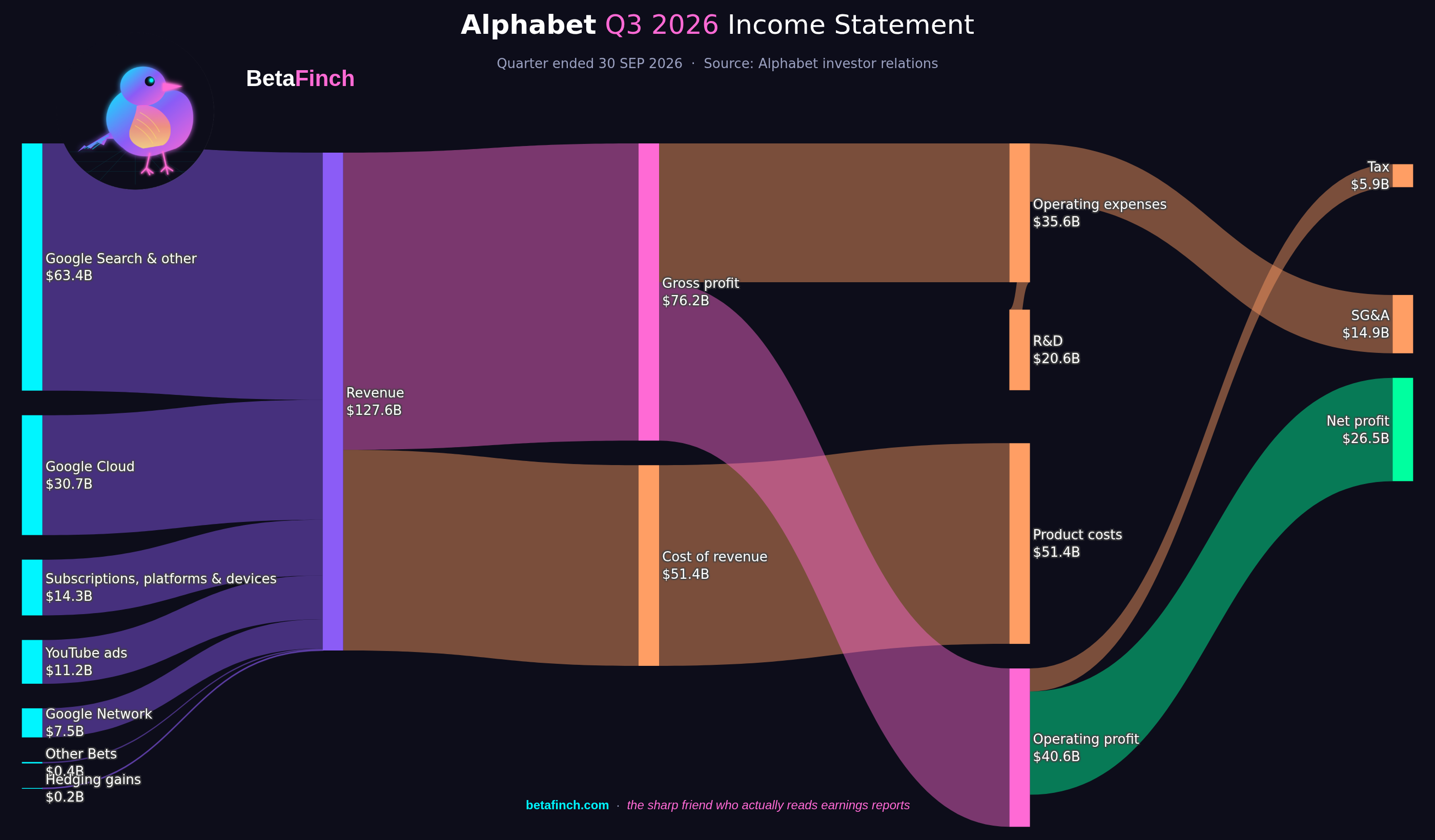
Alphabet grew revenue 25 percent to $127.6 billion in Q3 2026, but net income fell 24 percent as an $8.2 billion non-operating loss on equity securities hit the bottom line.
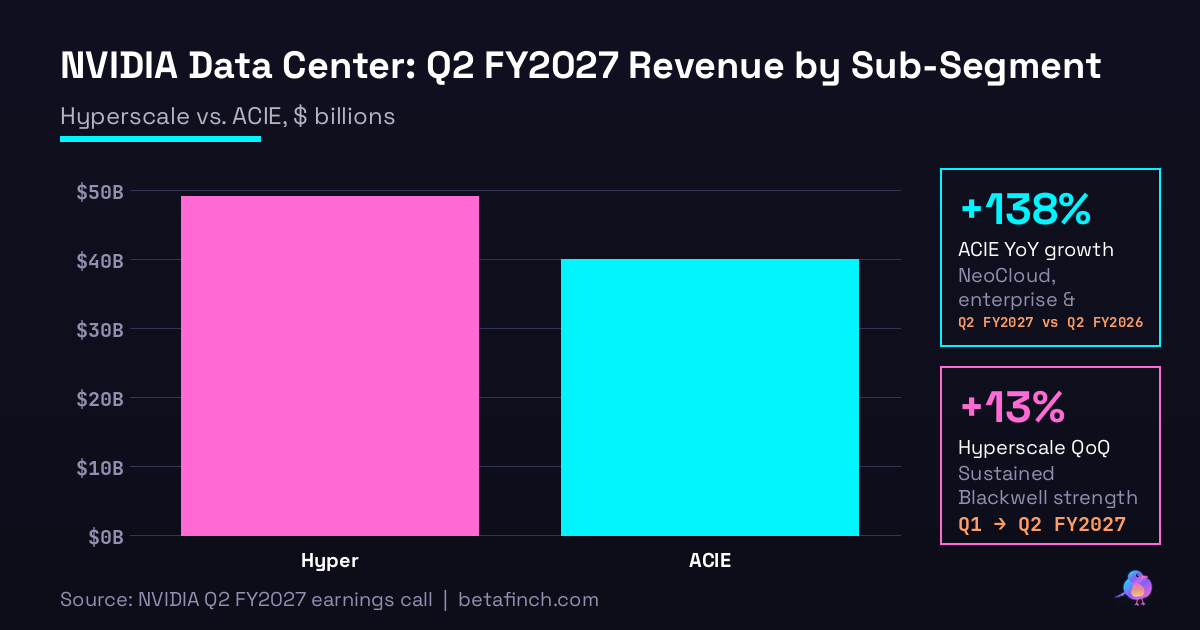
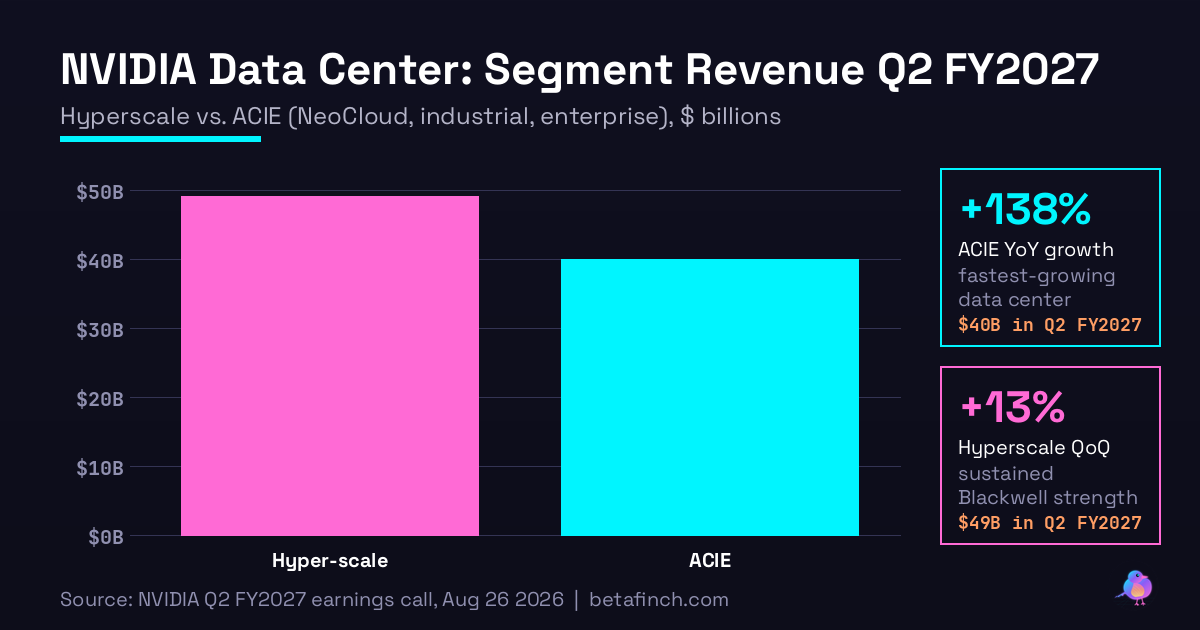
NVIDIA Q2 FY2027 data center revenue reached $89B, split between $49B hyperscale and $40B ACIE, as total revenue more than doubled year over year for the fourth consecutive quarter.
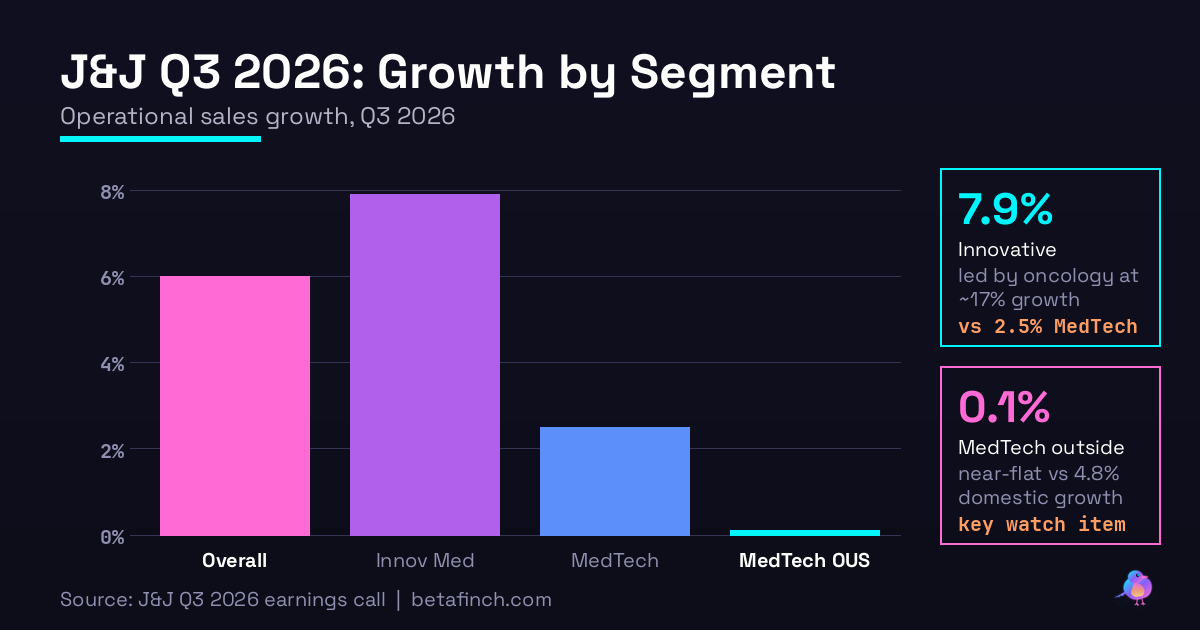
J&J reported $25.4B in Q3 2026 sales, up 6% operationally, with Innovative Medicine growing 7.9% versus MedTech at just 2.5% outside the U.S.
NVIDIA posted $96B in Q2 FY2027 revenue as data center hit $89B, with ACIE growing +25% sequentially and +138% year-over-year, outpacing hyperscale.
Data center is now 93 percent of NVIDIA revenue: Q2 FY2027 came in at $96B, with the data-center segment at $89B and its ACIE sub-segment up 138 percent year over year.
NVIDIA Q2 FY2027 total revenue reached $96 billion, more than double year-over-year, with data center at $89 billion and Q3 guided to $108 billion amid supply-driven constraints.
Apple posted a June quarter revenue record of $109.4B but guided to 9-11% growth in September, with memory cost pressure and tariff distortions shaping the outlook.
NVIDIA posted $96B in Q2 FY2027 revenue, more than double year over year, with the ACIE data center segment up 138% as sovereign and enterprise AI demand outpaces supply.
NVIDIA reported $96 billion in Q2 FY2027 revenue, more than double year-over-year, as enterprise and sovereign AI deployments grew to roughly half of data center revenue.
Apple's fiscal Q3 2026 hit a record $109.4B in revenue (+16% YoY) — iPhone +22%, Services a record $30.7B, and Q4 guidance of 9-11%. See the full breakdown.
NVIDIA posted $96 billion in Q2 FY2027 revenue, more than doubling year-over-year, while guiding Q3 to $108 billion amid DRAM-driven margin pressure.
Amazon's Q2 2026 results offer a live case study in earnings transcript literacy. Here is the framework for finding the numbers that matter.
Uber's trailing 12-month free cash flow topped $10 billion for the first time, as Q2 gross bookings exceeded $58B and non-GAAP EPS grew 35% year over year.
Four bellwether companies across energy, finance, retail, and industrials posted Q2 2026 results shaped by geopolitics, tariff policy, and physical infrastructure demand.
With four straight quarters of accelerating growth, the $79 billion analyst consensus for NVIDIA's Q1 FY2027 reflected a business where supply, not demand, set the ceiling.
NVIDIA posted $96B in Q2 FY2027 revenue, up more than 100% year-over-year, as data center demand outpaced supply capacity and DRAM costs began compressing gross margins.
Amazon raised 2026 capex guidance to $220 billion and reported AWS growth of 36.7%, the fifth consecutive acceleration quarter, as Q2 revenue reached $200.6 billion.
Apple posted a June quarter record of $109.4B in revenue, up 16% YoY, with EPS of $2.02 (+29%), as memory cost pressures and FX headwinds shape a softer September outlook.
Q2 2026 results from Pfizer, J&J, and Merck show why GAAP headlines can mislead and how to read past the noise to assess underlying business performance.
J&J posted $25.3B in Q2 2026 sales with 5.6% operational growth; strip out STELARA biosimilar erosion and the underlying business expanded double digits, prompting a full-year guidance raise.
All three retailers beat Q2 2027 estimates, but tariff refund windfalls complicate the underlying profit picture at Walmart, TJX, and Home Depot.
Walmart and TJX both beat Q2 2027 expectations, but each result carries a caveat: a $2.9B tariff windfall distorted Walmart's profit figures, while Marmaxx lagged TJX's consolidated comp.
Both retailers beat Q2 2027 estimates, but a $2.9B Walmart tariff refund and a self-inflicted Marmaxx comp miss define the real stories.
NVIDIA reported $82 billion in Q1 2027 revenue, up 85% year-over-year. Here is exactly where to find the live audio, replays, and AI breakdowns.
Gilead's HIV franchise hit $6.9B in Q1 product sales and closed $11.5B in acquisitions, while Moderna and Amgen each navigated their own pipeline trade-offs.
AWS grew 28% in Q1 2026, its fastest rate in 15 quarters, while Amazon posted a record 13.1% operating margin on $181.5 billion in revenue.
Regeneron, Vertex, and Gilead each posted revenue growth in Q1 2026, led by DUPIXENT's near-$20B run rate, Vertex's 27-day regulatory filing record, and Gilead's $11.5B acquisition wave.
Amazon posted a record 13.1% operating margin and 28% AWS growth in Q1 2026, with AI revenue and custom silicon as structural drivers.
Microsoft's ~$190 billion in projected 2026 capital expenditures and Nvidia's $75 billion quarterly data center revenue position AI infrastructure as a measurable driver of US fixed investment.
A framework for reading biotech earnings calls, illustrated with Regeneron, Vertex, and Gilead Q1 2026 data on revenue, pipeline readouts, and M&A.
Microsoft and Meta alone are projecting over $315 billion in 2026 AI infrastructure spending, approaching 1% of US nominal GDP. Earnings calls now quantify the scale.
Amazon reported Q1 2026 revenue of $181.5 billion, up 17% year-over-year, with AWS growing 28% to $37.6 billion, its fastest rate in 15 quarters.
AMD reports Q2 2026 results on August 5, with a $11.2B revenue guide and record data center momentum setting the baseline for investors.
Amazon posted $181.5 billion in Q1 2026 revenue and a record 13.1% operating margin, while AWS grew 28% to $37.6 billion, its fastest pace in 15 quarters.
Amazon posted $181.5B in Q1 2026 revenue with a record 13.1% operating margin, while AWS grew 28% year over year, its fastest pace in 15 quarters.
Amazon posted Q1 2026 revenue of $181.5B (+17% YoY) with a record 13.1% operating margin, while AWS grew 28%, its fastest pace in 15 quarters.
Amazon posted $181.5B in Q1 2026 revenue with a 13.1% operating margin, while AWS grew 28% to $37.6B on a $150B annualized run rate.
Amazon reported Q1 2026 revenue of $181.5 billion, up 17% year over year, with a 13.1% operating margin that CEO Andy Jassy called the highest in company history.
Amazon posted a record 13.1% operating margin and 28% AWS growth in Q1 2026, with AI revenue scaling 260x faster than AWS itself did in its first three years.
Costco's membership model and pricing discipline underpin a low-beta profile, while digital retention trends and tariff complexity introduce incremental 2026 risk.
Vertex posted Q1 2026 revenue of $2.99B, up 8% YoY, with new therapies and a record-speed renal submission pointing toward a potential fourth major franchise.
NVIDIA posted $82 billion in Q1 2027 revenue, up 85% year-over-year, led by $75 billion in data center revenue and the introduction of the Vera CPU platform.
T-Mobile reported 11% service revenue growth in Q1 2026, four times faster than its nearest competitor, while adding over 500,000 broadband customers.
All three retailers beat Q1 2027 estimates, but Walmart's platform flywheel, TJX's margin expansion, and Lowe's housing resilience tell divergent stories.
All three retailers beat Q1 2027 estimates through divergent strategies: Walmart on eCommerce and alternative revenue, TJX on off-price margin expansion, and Lowe's on AI-driven conversion.
Amazon posted $181.5B in Q1 2026 revenue at a record 13.1% operating margin, as AWS grew 28% to a $150B annualized run rate.
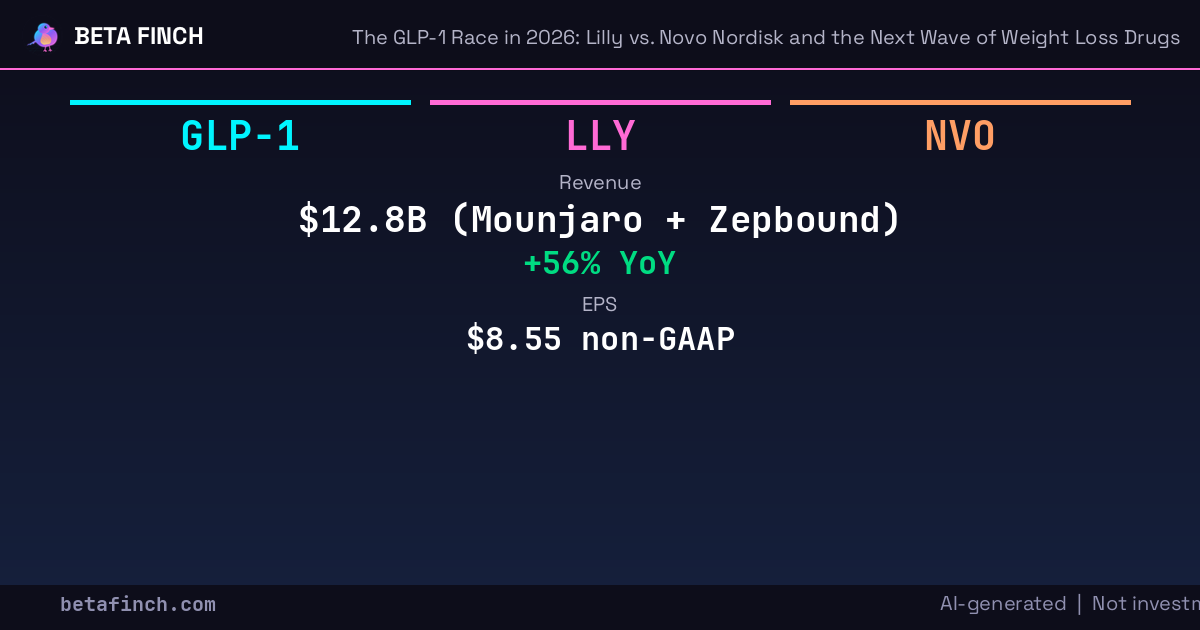
Lilly's Mounjaro and Zepbound combined for $12.8 billion in Q1 2026 as new oral GLP-1 Koundeo opens a second competitive front against Novo Nordisk's semaglutide franchise.
Top-five cloud provider capex expectations have climbed to nearly $700 billion in 2026, up $120 billion since January, with Microsoft and NVIDIA anchoring the cycle.
Disney's mix of cyclical parks and secular-growth streaming shapes a volatility profile long-term investors need to understand before sizing a position.
Nvidia posted 73% revenue growth and $68B in Q4 2026, yet its stock swings sharply on macro news. Beta explains why, and what that means for sizing a position.
Visa, Mastercard, and S&P Global reported 2026 results that show each company converting core data assets into AI-native, higher-margin revenue streams.
Walmart grew adjusted operating income 10.5% against 4.9% revenue growth; TJX hit $17.7B in Q4 sales with a stacked 5% comp. Two divergent retail playbooks.
Walmart's Q4 2026 results show operating income growing at more than double the rate of sales, driven by $6.4B in advertising and an accelerating AI and e-commerce platform.
Eli Lilly holds 60% of the US obesity market. Novo Nordisk's CagriSema just lost a head-to-head trial against tirzepatide. Behind them, five challengers are racing toward Phase 3. Here is where every major GLP-1 program stands heading into the second half of 2026.
Walmart's Q4 2026 results show adjusted operating income growing at more than double the revenue pace, with advertising and membership fees funding nearly one-third of operating income.
Palantir posted $1.63 billion in Q1 2026 revenue, up 85% year-over-year, its fastest growth rate as a public company, and raised full-year 2026 guidance to $7.656 billion.
Deere & Company posted Q1 2026 net sales of $9.6 billion, up 13% year-over-year, as Construction & Forestry surged 34% and management declared 2026 the bottom of the agricultural cycle.
Caterpillar posted Q1 2026 revenue of $17.4B (+22% YoY) with a record $63B backlog driven by data center power demand. But $2.2-$2.4B in tariff exposure creates binary risk for the rest of the year.
AWS posted its fastest growth in 15 quarters while Microsoft Cloud hit $54B in Q3 2026. Here is what the headline numbers and CapEx commitments reveal.
Meta, Apple, Amazon, Netflix, and Alphabet all reported within the same earnings window, posting record revenues, expanded margins, and rising AI capital commitments.
The Bureau of Economic Analysis put real GDP growth at 2.0% annualized in Q1 2026. Strip out spending on computer equipment and software (the categories carrying most of the AI buildout), and the picture changes substantially. AI capital formation is now roughly 5% of US GDP, a level last seen during the late-1990s technology boom.
When Microsoft, Alphabet, and Amazon reported Q1 2026, a surprising share of the headline numbers traced back to two private companies they don't own outright. Cloud commitments, equity stake markups, and AI run-rate disclosures all point to Anthropic and OpenAI as load-bearing inputs to Big Tech's earnings.
Big Tech revenue keeps growing. Free cash flow does not. The Q1 2026 reports made the gap between operating performance and cash generation impossible to ignore. Amazon's TTM free cash flow fell 95%. Alphabet's quarterly FCF dropped 47%. Apple alone kept the old shape intact.
Q1 2026 earnings calls turned the AI capex race into a numbered game. Microsoft, Alphabet, Meta, Amazon, and Apple disclosed full-year spending plans that vary by an order of magnitude. Here is what each company committed to, and what they say the money is for.
Walmart Q4 2026: advertising and membership now fund a third of operating income. Sparky AI drives 35% higher basket sizes. Operating income grew at 2x the revenue rate. The platform transition is no longer theoretical.
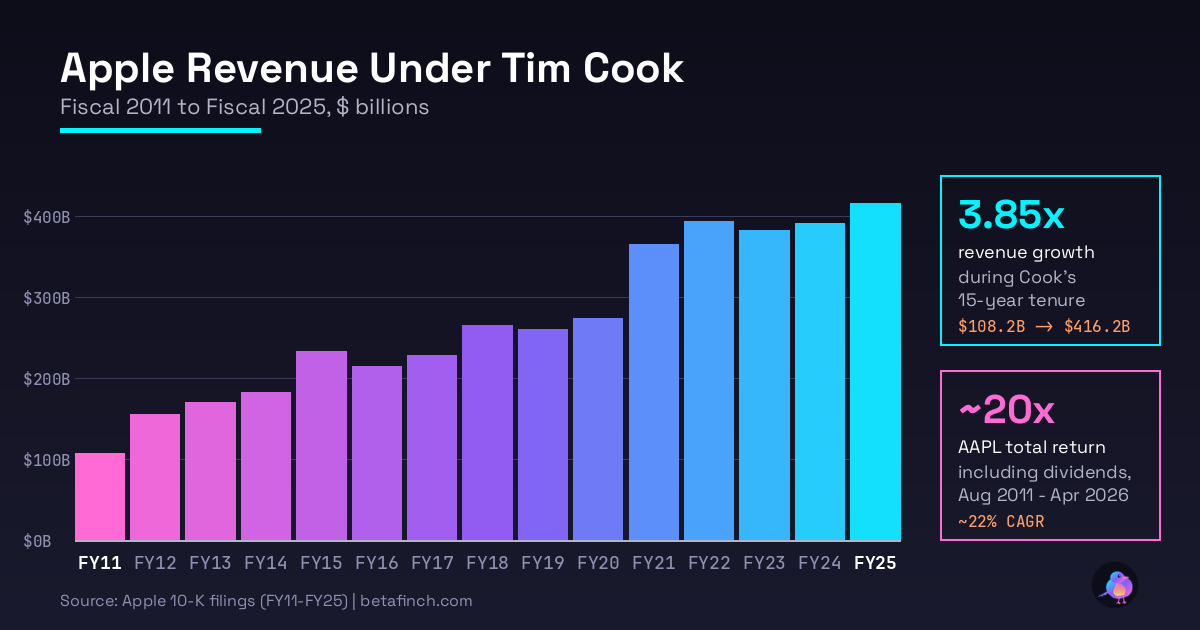
Tim Cook became Apple CEO in August 2011 and steps aside in September 2026. The financial record of his tenure is already written.
Quarterly earnings calls from major banks contain critical information about the economy, interest rates, and credit markets. Here is how to use banking podcasts to stay informed without reading 50-page transcripts.

JPMorgan Chase, Goldman Sachs, and Wells Fargo all reported Q4 2025 results. Revenue growth across all three banks signals a strong quarter for the financial sector, though the drivers differ significantly.