Apple Q4 FY2026 Earnings: Record Revenue, Services High, and What Investors Watch Next
Apple (AAPL) reported fiscal fourth quarter 2026 revenue of $114.5 billion, up 12% year over year, marking a September quarter record. The result capped what the company described as its best fiscal year ever for both total revenue and diluted earnings per share, with quarterly diluted EPS reaching $2.10, up 14% year over year. The quarter reflected strength across iPhone, Mac, and Services, with the latter posting an all-time revenue record for the segment.
Segment Revenue Breakdown
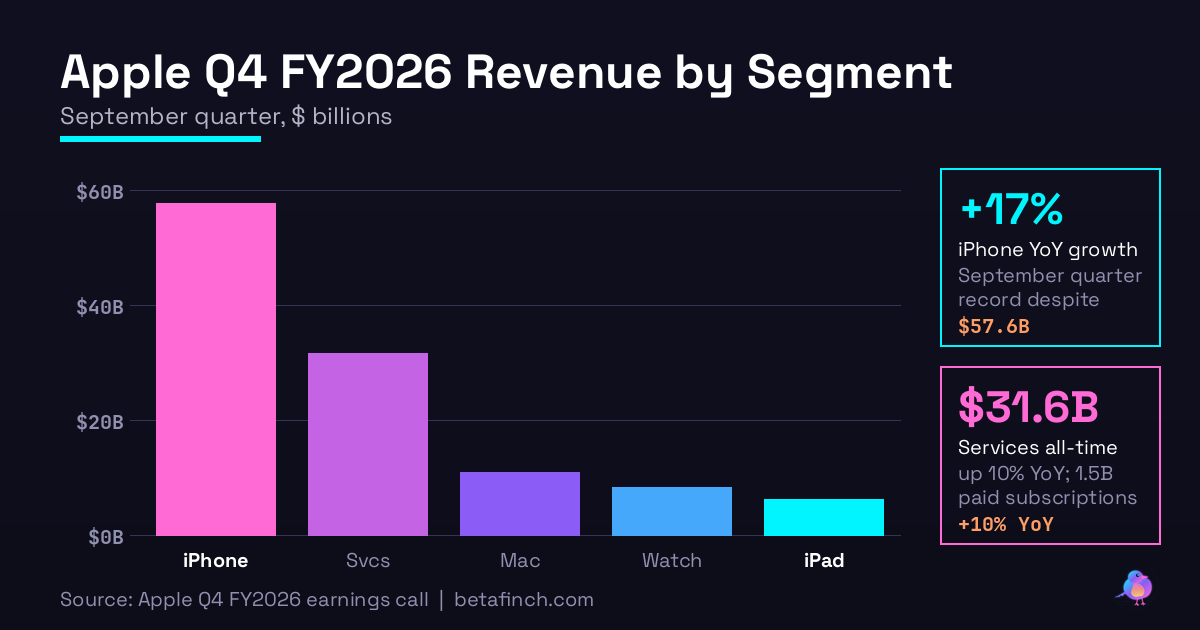
iPhone revenue came in at $57.6 billion for the September quarter, up 17% year over year. Management cited ongoing supply constraints and foreign exchange headwinds as factors during the quarter, yet demand remained robust enough to drive a 17-point revenue gain. The iPhone Duo lineup, which began shipping in late September, generated early demand that management characterized as strong relative to prior cycles.
Services revenue reached $31.6 billion, up 10% year over year, an all-time record for the segment. Mac revenue was $10.8 billion, up 24% year over year, the strongest hardware segment growth rate in the quarter despite supply constraints that management noted limited the ceiling on results. iPad revenue came in at $6.2 billion, while Wearables, Home and Accessories contributed $8.3 billion.
Key Numbers
Revenue: $114.5B
EPS: $2.10
Revenue Growth: +12%
Margins and Cash Flow
Gross margin for the quarter came in at 47.9%. Management noted that tariff benefits contributed approximately one percentage point to the figure, while memory pricing pressure provided a partial offset in the other direction. The net result placed Apple at the high end of the guidance range that management had provided in the prior quarter earnings call.
Operating cash flow reached $28.1 billion in the quarter, a record level. That figure reflects the compounding effect of a larger Services mix, which carries higher margins than hardware, alongside operational efficiency in the hardware supply chain. The record operating cash flow supports Apple's capital return program, which includes share repurchases and dividends as disclosed in the quarterly filing.
The gross margin trajectory remains a focal point for analysis. The approximately one-point tariff benefit is not guaranteed to persist, and management did not commit to its continuation into the December quarter at the same magnitude. Memory pricing conditions can also shift. The 47.9% figure therefore contains both structural and transitory components, and the December quarter will help clarify which portions of that margin are durable.
The Installed Base and Subscription Engine
Apple's installed base of active devices exceeded 2.5 billion across all hardware categories, including iPhone, Mac, iPad, Apple Watch, and Apple TV. That base represents the addressable universe for Apple's Services segment, providing the platform through which subscriptions, app purchases, and digital transactions flow. With Services revenue now at $31.6 billion per quarter and growing at 10% year over year, the revenue generated per active device is expanding as the base itself grows.
Paid subscriptions across Apple's services ecosystem reached 1.5 billion and grew double digits year over year, the company reported. The subscription figure spans Apple TV+, Apple Music, iCloud+, Apple Arcade, Apple One bundles, and third-party subscriptions processed through the App Store. A 1.5 billion subscription count across a 2.5 billion active device base implies broad penetration, noting that many users subscribe to multiple services and that some devices are shared across households.
Apple Pay extended its reach during the quarter, now available in over 90 markets. A new launch in India through a partnership with Axis Bank brought one of the world's largest consumer markets into the Apple Pay footprint. Financial services represent a growing layer within the broader ecosystem, complementing subscription-based revenue streams with transaction-linked monetization that scales with commerce activity.
Capital Allocation Context
$28.1 billion in operating cash flow for a single quarter positions Apple to continue its established capital return program at significant scale. The company has executed multi-year share repurchase authorizations that have meaningfully reduced the diluted share count over time. That reduction amplifies EPS growth relative to net income growth, which is the key dynamic behind the 14% EPS gain on a 12% revenue gain in Q4 FY2026.
Diluted EPS of $2.10 for the quarter reflects both underlying earnings growth and the mathematical effect of a smaller outstanding share count from sustained share repurchases. The company's approach to capital allocation has been consistent over multiple fiscal years: return excess cash through repurchases and dividends while reducing the net cash position over time. Those details are disclosed in Apple's 10-K and quarterly 10-Q filings.
What to Watch in the December Quarter
Management guided for December quarter revenue growth in the range of approximately 7% to 10% year over year. That range reflects a full quarter of iPhone Duo availability, the holiday selling season that historically drives Apple's highest quarterly revenue figure, and continued expansion in Services. The guidance range is consistent with the trajectory of recent December quarters but does not assume an acceleration beyond the current growth rate.
The Siri AI rollout represents a significant variable for the product cycle. Apple launched Siri AI in beta form during the quarter and indicated plans to expand language support progressively in the months ahead. The pace of that expansion, and whether consumers in key markets perceive the AI features as meaningful enough to accelerate device refresh decisions, will be central questions heading into fiscal 2027. More detail on the Siri AI features and their rollout timeline is covered in the [Apple Q4 FY2026 earnings episode](/podcasts/AAPL_Q4_2026).
Wearables and Mac both face supply-side uncertainty that management flagged explicitly for the December quarter. The 24% Mac growth in Q4 was achieved despite constraints, suggesting that satisfied demand could have been higher. How those supply conditions resolve, combined with the holiday demand environment, will shape the first look at Apple's fiscal 2027 trajectory. Listeners following AAPL across earnings periods can find the full archive of episodes at [Apple's coverage page on Beta Finch](/groups/AAPL).
Key Numbers at a Glance
- Q4 FY2026 Revenue: $114.5B, up 12% year over year (September quarter record)
- iPhone Revenue: $57.6B, up 17% year over year
- Services Revenue: $31.6B, up 10% year over year (all-time record)
- Mac Revenue: $10.8B, up 24% year over year
- iPad Revenue: $6.2B for the September quarter
- Wearables, Home and Accessories Revenue: $8.3B for the September quarter
- Gross Margin: 47.9%, including approximately 1 percentage point from tariff benefits
- Diluted EPS: $2.10, up 14% year over year
- Operating Cash Flow: $28.1B (record quarter)
- Active Device Base: Over 2.5 billion
- Paid Subscriptions: 1.5 billion, growing double digits year over year
- Apple Pay: Available in over 90 markets, with new launch in India via Axis Bank