Walmart vs. TJX Q3 2027: Two Retail Giants, Two Winning Formulas
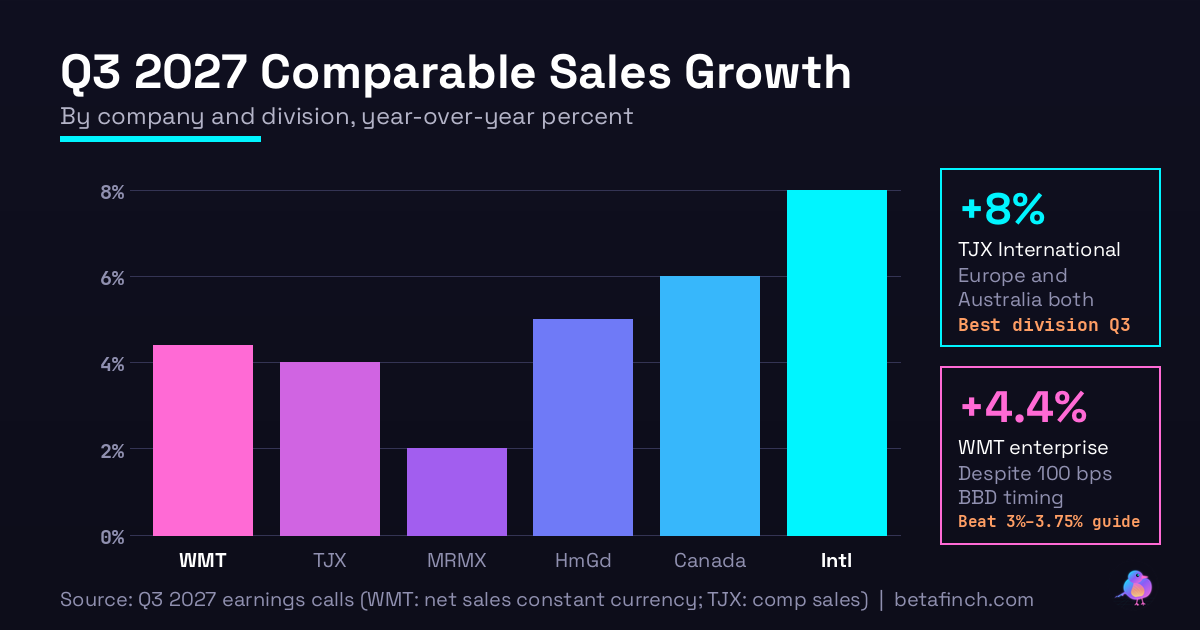
Walmart (WMT) and TJX Companies (TJX) reported Q3 2027 results that exceeded expectations, arriving through fundamentally different retail strategies. Walmart posted enterprise net sales growth of 4.4% in constant currency, clearing the high end of its own guidance range of 3%–3.75%. TJX delivered consolidated comparable sales growth of 4%, above plan, driven by higher average basket and increased customer transactions. The parallel results reflect how digital scale and physical off-price execution are each generating growth in a retail environment shaped by divergent consumer priorities.
Walmart’s Digital Flywheel
Walmart’s global e-commerce grew 17% in Q3 2027, with the U.S. segment accelerating to 23% growth and Sam’s Club reaching 30%. U.S. marketplace sales rose nearly 50%, as third-party seller participation on Walmart.com continued expanding across categories. The results mark a sustained trajectory across general merchandise, grocery, pharmacy, and advertising, segments that each contribute to the digital platform’s broader economics.
The fulfillment architecture behind those numbers relies heavily on the existing store network. More than 80% of Walmart U.S. e-commerce orders are fulfilled from stores, and store-fulfilled deliveries increased over 40% in Q3. The company’s store footprint covers over 96% of U.S. households within a three-hour delivery window, converting existing physical infrastructure into last-mile capacity with favorable unit economics compared with purpose-built distribution centers serving the same geography.
Adjusted operating income grew 5.5% in constant currency in Q3. Walmart raised full-year operating income guidance to 8%–8.6% from the previous range of 7%–8.5%, and lifted EPS guidance to $2.84–$2.89 from $2.80. Full-year sales guidance was raised to 4.9%–5.2%. One headwind moderated the U.S. comparable figure: Medicare Formulary Protection program pharmacy pricing created approximately 125 basis points of drag on U.S. comparable sales, which came in at 2.9%. Underlying general merchandise and grocery trends held firm excluding that effect.
Key Numbers
Revenue Growth: +4.4%
EPS: $2.84–$2.89 (FY guidance)
Membership and the $120 Bundle
Walmart launched a bundled membership combining Walmart+ and Sam’s Club Plus at $120 per year, which the company described as the equivalent of $10 a month. The bundle consolidates two loyalty programs into a single entry point, extending same-day delivery access, fuel discounts, and member pricing across both banners. The entry price positions the product against competing membership programs in both grocery and warehouse club categories.
Membership reinforces the digital flywheel by increasing basket frequency and depth. Subscribers generate purchase data that improves marketplace relevance and advertising yield on Walmart’s retail media platform, which is built on first-party transaction data and store-level reach. The bundled structure lowers acquisition friction for households that shop across both Walmart and Sam’s Club, widening the addressable subscriber base for the combined offering.
TJX’s Physical Breadth and International Lead
TJX achieved Q3 2027 consolidated comp sales of 4%, with international segments posting the highest growth rates. TJX International comps grew 8%; TJX Canada grew 6%. HomeGoods comparable sales rose 5%, reflecting sustained demand for home categories at off-price value points. The international performance, spanning Europe and Australia in addition to Canada, illustrates a geographic diversification that provides growth levers independent of U.S. consumer conditions.
Marmaxx, TJX’s largest segment by store count, posted a 2% comparable sales increase in Q3. That result came against a strong 6% comparable in the prior year period; the two-year stack of 8% provides context for the trajectory. Marmaxx segment profit margin was 13.8%, down 110 basis points year over year, with higher freight and fuel costs identified as the primary drivers. The margin pressure was largely contained within Marmaxx; international and HomeGoods segments held firmer margin lines.
TJX’s model rests on opportunistic inventory acquisition rather than forward demand forecasting. The company sources merchandise through vendor closeouts and in-season buying, flowing fresh assortments to stores continuously. That process sustains the differentiated, rotating inventory that encourages repeat visits and elevates transaction counts. Management cited outstanding merchandise availability entering the holiday period, with fresh gifting assortments arriving weekly. The off-price format benefits from vendor inventory cycles that tend to surface more buying opportunity during periods of broader retail uncertainty.
Key Numbers
Revenue Growth: +4%
EPS: $1.34
Revenue: $63.8B–$64B (FY guidance)
Guidance and Margin Pressures
TJX raised full-year revenue guidance to $63.8 billion–$64 billion and adjusted EPS guidance to $5.17–$5.20. Full-year pre-tax margin guidance stands at 12%–12.1%. Q3 adjusted EPS came in at $1.34, with adjusted pre-tax profit margin at 12.5%. For Q4, TJX guided comparable sales growth of 2%–3%, a range that reflects both the competitive holiday environment and the prior-year comparable base.
The two retailers face distinct cost exposures. Walmart navigates pharmaceutical pricing dynamics in its U.S. segment, where Medicare Formulary Protection program effects flow through gross margin calculations, alongside timing of tariff refunds that affects period-over-period comparability. TJX’s cost pressure centers on freight and fuel, which concentrated in Marmaxx given its domestic store base. International and HomeGoods cost structures are less exposed to domestic freight cycles, which helps explain the divergence in segment margin performance across TJX’s banners.
Holiday Positioning
Walmart is deploying agentic commerce tools and delivery speed as holiday period differentiators. Restaurant partnerships and food delivery integration extend the utility of Walmart+ beyond core grocery and general merchandise, adding value for time-sensitive purchases. The three-hour household coverage positions the company competitively for last-minute gift fulfillment across both digital and physical formats.
TJX enters Q4 with what management described as among its best-ever assortment availability. The off-price format’s weekly merchandise flows mean consumers encounter fresh selections on each visit, a dynamic that sustains transaction frequency through gift-buying seasons. Both companies enter the fourth quarter with raised full-year guidance, reflecting confidence in demand conditions across different retail formats.
Q3 2027 at a Glance
- Walmart enterprise net sales +4.4% constant currency, above the 3%–3.75% guidance range
- Walmart global e-commerce +17%; U.S. +23%, Sam’s Club +30%; U.S. marketplace sales +nearly 50%
- Over 80% of Walmart U.S. e-commerce orders fulfilled from stores; store-fulfilled deliveries +over 40%
- Walmart FY operating income guidance raised to 8%–8.6%; EPS guidance raised to $2.84–$2.89
- TJX consolidated comp +4%; International +8%, Canada +6%, HomeGoods +5%, Marmaxx +2%
- TJX Marmaxx segment profit margin 13.8%, down 110 basis points from freight and fuel costs
- TJX FY revenue guidance raised to $63.8B–$64B; adjusted EPS guidance $5.17–$5.20
For a full breakdown of each quarter, the Beta Finch earnings podcasts cover both reports in depth. Listen to the [Walmart Q3 2027 earnings podcast](/podcasts/WMT_Q3_2027) and the [TJX Q3 2027 earnings podcast](/podcasts/TJX_Q3_2027) for the complete management commentary, segment details, and analyst Q&A.