Apple Q4 FY2026 Earnings: Record Revenue, iPhone Surge & December Guidance
Key Numbers
Revenue: $114.5B
EPS: $2.10
Revenue Growth: +12%
Apple (AAPL) reported September-quarter revenue of $114.5 billion, up 12% year-over-year and a September-quarter record. Diluted earnings per share reached $2.10, up 14% year-over-year. Operating cash flow of $28.1 billion also set a record for the quarter, reflecting broad profitability across hardware and services categories.
The 12% revenue growth rate was driven by an exceptional performance in the iPhone lineup and an accelerating Services segment. Gross margin reached 47.9%, supported in part by approximately 1 percentage point of tariff benefit that management highlighted on the call.
iPhone Revenue: A September Quarter Record
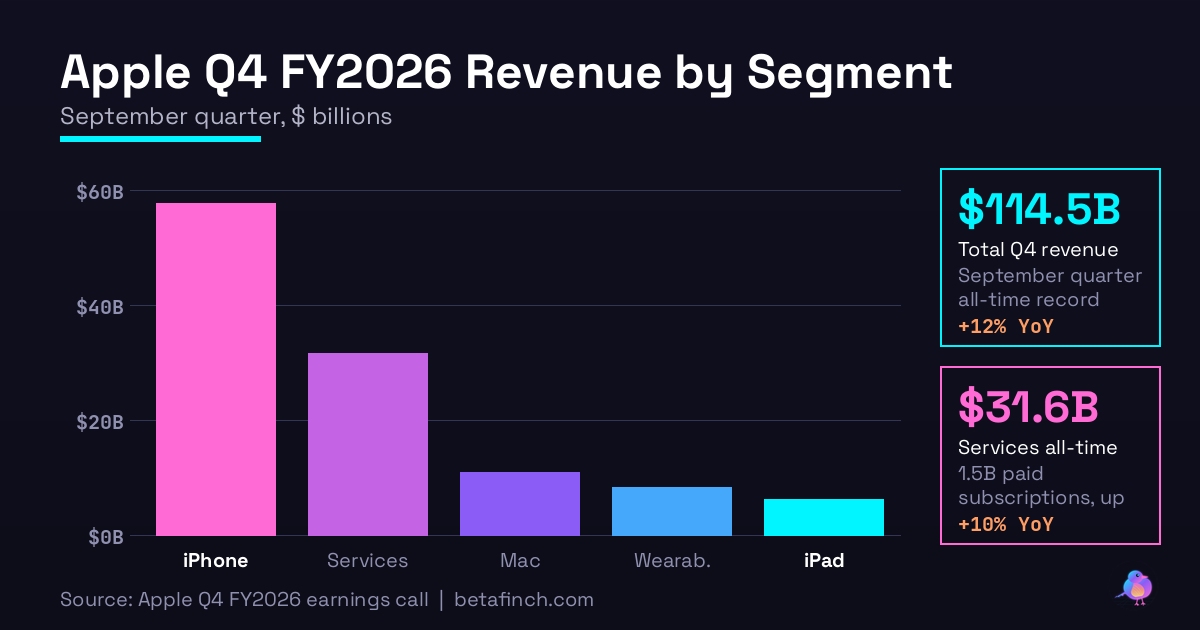
iPhone revenue came in at $57.6 billion, up 17% year-over-year and a September-quarter record, despite supply constraints and foreign exchange headwinds that management noted on the call. Upgrader records were reported in the United States, China, and India, three of Apple's most closely watched geographic markets. The iPhone Duo foldable launch appears to have driven a meaningful acceleration in the upgrade cycle, pulling demand that might otherwise have spread across future quarters into the September period.
The 17% growth rate stands well above the category's historical average in mature markets. Supply limitations capped the reported figure, meaning actual consumer demand likely ran ahead of what shipped, a point management framed as a potential tailwind into the December quarter as supply-chain constraints ease. India continues to emerge as a volume growth driver, with local manufacturing expanding Apple's ability to serve that market at scale.
The iPhone's $57.6 billion contribution represented roughly 50% of total quarterly revenue, underscoring how central the product cycle remains to overall results even as Services grows as a share of the revenue mix. The simultaneous records in both revenue and unit upgrader counts across three major geographies reinforce the breadth of the cycle rather than its concentration in a single market.
Services: An All-Time Record
Services revenue reached $31.6 billion in the September quarter, up 10% year-over-year and an all-time record for the segment. Apple's active device installed base exceeded 2.5 billion, the platform from which the company monetizes recurring revenue through the App Store, Apple Music, iCloud, Apple TV+, Apple Arcade, and Apple One bundles. Paid subscriptions reached 1.5 billion and grew double digits year-over-year, reflecting continued expansion across both standalone and bundled offerings.
At $31.6 billion in a single quarter, the Services segment is running at an annualized pace of roughly $120 billion, a scale that places it among the largest software and subscription businesses globally. The segment's structural margin advantage over hardware means its growing revenue share acts as a partial offset to hardware cost variability. Services now represents approximately 28% of Apple's quarterly revenue, compared with less than 15% five years ago, a shift that management has consistently described as a deliberate long-term priority.
Mac, iPad, and Wearables
Mac revenue was $10.8 billion for the September quarter, up 24% year-over-year despite supply constraints. The company cited IDC data indicating market share gains in several regions. The Mac growth rate outpaced all other hardware segments in the quarter, partly reflecting the cadence of Apple Silicon refreshes across the professional and consumer lineups, and partly benefiting from a relatively favorable year-over-year comparable.
iPad revenue was $6.2 billion for the September quarter. Wearables, Home and Accessories contributed $8.3 billion. The combined hardware segments outside iPhone and Mac totaled approximately $14.5 billion, rounding out a quarter in which every major product category posted positive year-over-year growth. The breadth of gains across segments signals that the September-quarter record was not driven by a single product cycle in isolation.
Gross Margin and Operating Cash Flow
Gross margin reached 47.9% in the September quarter. Management attributed approximately 1 percentage point of that figure to a tariff benefit tied to current trade policy conditions, a component that may not persist at the same magnitude in future quarters. The underlying question of what the gross margin baseline looks like if that benefit moderates, combined with rising memory costs, is a variable management acknowledged directly on the call.
Services' structural margin premium over hardware continues to support overall gross margin as the revenue mix evolves. Operating cash flow of $28.1 billion was a record for the September quarter, reflecting both the strong profitability of the period and working capital dynamics that typically favor the quarter following a major iPhone launch. The record cash flow figure provides context for the scale of capital Apple has available to allocate across buybacks, dividends, and strategic investments.
December Quarter Guidance and Siri AI
Apple guided for December-quarter revenue growth of plus 7% to plus 10% year-over-year, a range that encompasses the holiday selling period for hardware and continued Services momentum. The guidance was provided without a specific gross margin point estimate. Management flagged memory pricing as the key margin variable to watch: DRAM and NAND costs have been rising across the industry, and while Apple's procurement scale provides leverage, sustained input cost increases represent a headwind the company itself named as a risk to December-quarter margins.
Siri AI launched in beta for U.S. English users in September, with the rollout expanding to French, Japanese, Korean, Portuguese, and Spanish users in October. The feature integrates a more capable AI layer into the native Siri interface across iPhone, iPad, and Mac. Management framed the launch as a long-cycle investment in the installed base rather than a discrete near-term revenue event, with additional language and feature expansions planned for future quarters. The active device installed base of more than 2.5 billion represents the addressable surface for these AI capabilities as they deploy more broadly. How quickly AI features deepen user engagement, and whether that translates into higher subscription attach rates, is a metric to watch in coming quarters.
Key Numbers at a Glance
- Q4 FY2026 revenue: $114.5 billion, up 12% year-over-year, a September-quarter record
- iPhone revenue: $57.6 billion, up 17% year-over-year, a September-quarter record despite supply constraints and foreign exchange headwinds
- Services revenue: $31.6 billion, up 10% year-over-year, an all-time record for the segment
- Mac revenue: $10.8 billion, up 24% year-over-year despite supply constraints
- iPad revenue: $6.2 billion; Wearables, Home and Accessories: $8.3 billion
- Diluted EPS: $2.10, up 14% year-over-year
- Gross margin: 47.9%, including approximately 1 percentage point of tariff benefit
- Operating cash flow: $28.1 billion, a September-quarter record
- Active device installed base: more than 2.5 billion
- Paid subscriptions: 1.5 billion, growing double digits year-over-year
- December-quarter revenue guidance: plus 7% to plus 10% year-over-year
For the full earnings call breakdown, listen to the Beta Finch Apple Q4 FY2026 earnings episode at betafinch.com/podcasts/AAPL_Q4_2026, or explore the complete Apple earnings coverage archive at betafinch.com/groups/AAPL.