NVIDIA FY2027 Revenue by Segment: What's Driving the Growth
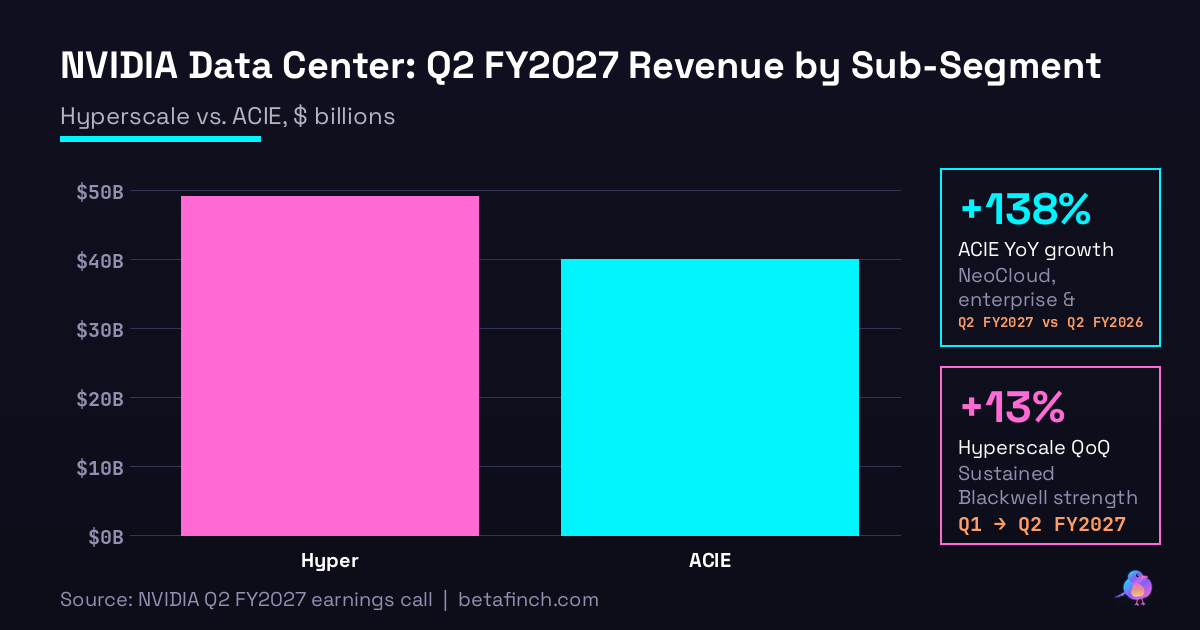
NVIDIA (NVDA) reported Q2 FY2027 total revenue of $96 billion, more than doubling year over year for the fourth consecutive quarter of accelerating growth. Data center, which accounted for $89 billion of that total, drove the overwhelming majority of the sequential gain, rising 18% quarter over quarter. The near-equal split between two structurally distinct customer segments, $49 billion from hyperscalers and $40 billion from the ACIE segment, is the key detail for understanding where revenue growth originates and where it is heading.
The Hyperscale Sub-Segment
The hyperscale segment covers large cloud providers, including Amazon Web Services, Microsoft Azure, Google Cloud, and Meta, that procure GPU compute at scale for foundation model training and inference. At $49 billion in Q2 FY2027, hyperscale revenue grew 13% sequentially. The demand signal from this group is concrete and long-dated: AWS is deploying an additional 2 million GPUs between Q2 FY2027 and Q2 FY2029, a multiyear commitment that illustrates the depth of planned buildout.
Capital expenditure from the top five hyperscalers is expected to reach approximately $800 billion in 2026, rising to $1.3 trillion in 2027. Those figures reflect a sustained acceleration of AI infrastructure investment that has continued to expand in scale. The AWS commitment of 2 million incremental GPUs over a two-year window is one concrete expression of that capex agenda; similar multiyear deployment programs are underway across the other major cloud platforms.
The ACIE Sub-Segment: NeoCloud, Enterprise, and Sovereign
ACIE encompasses the non-hyperscale portion of data center revenue: NeoCloud providers, industrial customers, enterprise deployments, and sovereign AI programs. At $40 billion in Q2 FY2027, ACIE revenue grew 25% sequentially and 138% year over year. Within that category, sovereign AI revenue grew 35% sequentially and more than tripled year over year, driven by government-sponsored compute buildout across multiple regions.
NeoCloud partners, a cluster of AI-focused infrastructure providers that operate between hyperscalers and traditional enterprise, are expanding their capacity significantly. NVIDIA expects NeoCloud partners to exit 2026 with 8 gigawatts of installed compute capacity, up from approximately 3 gigawatts at the end of 2025. That near-tripling of capacity within a single calendar year reflects a structural broadening of who is building AI infrastructure, extending well beyond the established cloud platforms.
Management expects the ACIE segment to represent roughly half of data center revenue going forward. Given the current $40 billion base and 138% year-over-year growth rate, that projection implies a continued widening of the customer base relative to hyperscale. The two sub-segments together illustrate that AI infrastructure spending is no longer concentrated in a handful of cloud providers.
Revenue per Gigawatt: Measuring Platform Value
One of the clearest illustrations of how NVIDIA's product roadmap translates into financial outcomes is the revenue-per-gigawatt metric. With the Hopper generation, a gigawatt of compute represented approximately $18 billion in revenue opportunity. With Blackwell, that figure rose to $25 billion. With Vera Rubin, the next-generation platform, NVIDIA projects $40 billion per gigawatt.
Each progression reflects more than raw GPU performance gains. Every generation ships with an expanded software stack, high-speed networking components, and full-rack systems integration that increase the average revenue per unit of compute deployed. As data centers are now planned and priced in gigawatts, the per-gigawatt metric serves as a direct measure of platform attach rate and pricing power across a product cycle.
The gross margin profile is consistent with a platform transition in progress. Gross margin came in at 75% in Q2 FY2027, flat quarter over quarter. NVIDIA has guided for a trough in the range of 71% to 72% in Q4 FY2027 as Blackwell reaches full production ramp. The per-gigawatt expansion to $40 billion with Vera Rubin establishes the mechanism for margin recovery beyond that trough.
Q3 Guidance and the FY2028 Outlook
NVIDIA guided Q3 FY2027 revenue to $108 billion, plus or minus 2%, representing continued sequential growth from the Q2 result. For the full FY2028 fiscal year, management communicated an expectation of approximately 70% revenue growth. That figure carries an important qualifier: NVIDIA described it as supply-constrained, not demand-constrained.
The distinction matters for interpreting the trajectory. Demand at every major cloud provider currently exceeds available GPU supply. The limiting factor is manufacturing capacity, meaning the pace at which TSMC, NVIDIA's assembly partners, and the broader supply chain can produce and deliver systems at scale. Revenue growth in FY2028 is therefore tied more directly to production yield and delivery timelines than to any change in customer appetite for AI compute.
That supply constraint framing also reinforces why the $800 billion in 2026 hyperscaler capex and the projected $1.3 trillion in 2027 matter as context. Those commitments are already in place; the question is how much NVIDIA can fulfill within each fiscal quarter given current manufacturing output. The approximately 70% FY2028 growth figure therefore represents a floor tied to supply availability rather than a ceiling driven by any reduction in customer demand.
What the Segment Structure Signals
Data center revenue at $89 billion now accounts for more than 90% of NVIDIA's total revenue, reflecting how thoroughly the product mix has shifted toward AI compute infrastructure over the past two fiscal years. Within that segment, ACIE at $40 billion is growing faster than hyperscale at $49 billion, and management's near-parity expectation going forward implies continued structural broadening of the customer base beyond the largest cloud providers.
The revenue-per-gigawatt roadmap, $18 billion with Hopper, $25 billion with Blackwell, and $40 billion with Vera Rubin, provides a framework for understanding how NVIDIA can sustain revenue growth across platform cycles even as unit GPU counts may stabilize. Each generation raises the revenue yield per unit of compute through expanded software, networking, and systems integration that extend the attach rate beyond the GPU itself.
For the detailed management discussion of segment dynamics, supply constraints, and the Blackwell-to-Vera Rubin roadmap, the full <a href="/podcasts/NVDA_Q2_2027">NVIDIA Q2 FY2027 earnings episode</a> is available in the Beta Finch library. Broader context on the AI compute cycle and competitive dynamics across chip manufacturers is covered in the <a href="/groups/semiconductors">semiconductors sector</a> collection.