The AI Buildout Ledger, Q3 2026: Who Is Spending, Who Is Borrowing, and What Has Been Promised
Welcome to the first edition of a quarterly series. Every quarter we track the money behind the AI boom: how much the biggest spenders are putting into chips and data centers, how much of it is borrowed, and the future purchase commitments, the deals where one company has agreed to pay another for compute. We lead with the public hyperscalers, whose numbers are filed with the SEC, then the private frontier labs, whose numbers are reported rather than filed. We flag every one of those.
This quarter's headline: the four largest hyperscalers spent more than $200 billion on property and equipment in a single quarter, and three of the four spent more than their businesses generated in operating cash, closing the gap with debt and balance-sheet cash. Widen the lens to all five public names in this ledger and capex of roughly $230 billion outran about $199 billion of combined operating cash flow, pushing the group's combined free cash flow to roughly negative $32 billion for the quarter. The borrowing is now out in the open too: the five together have issued about $296 billion of bonds in 2026 through November 9, well past the roughly $250 billion the market had expected for the full year (aggregate and bond totals are reported figures).
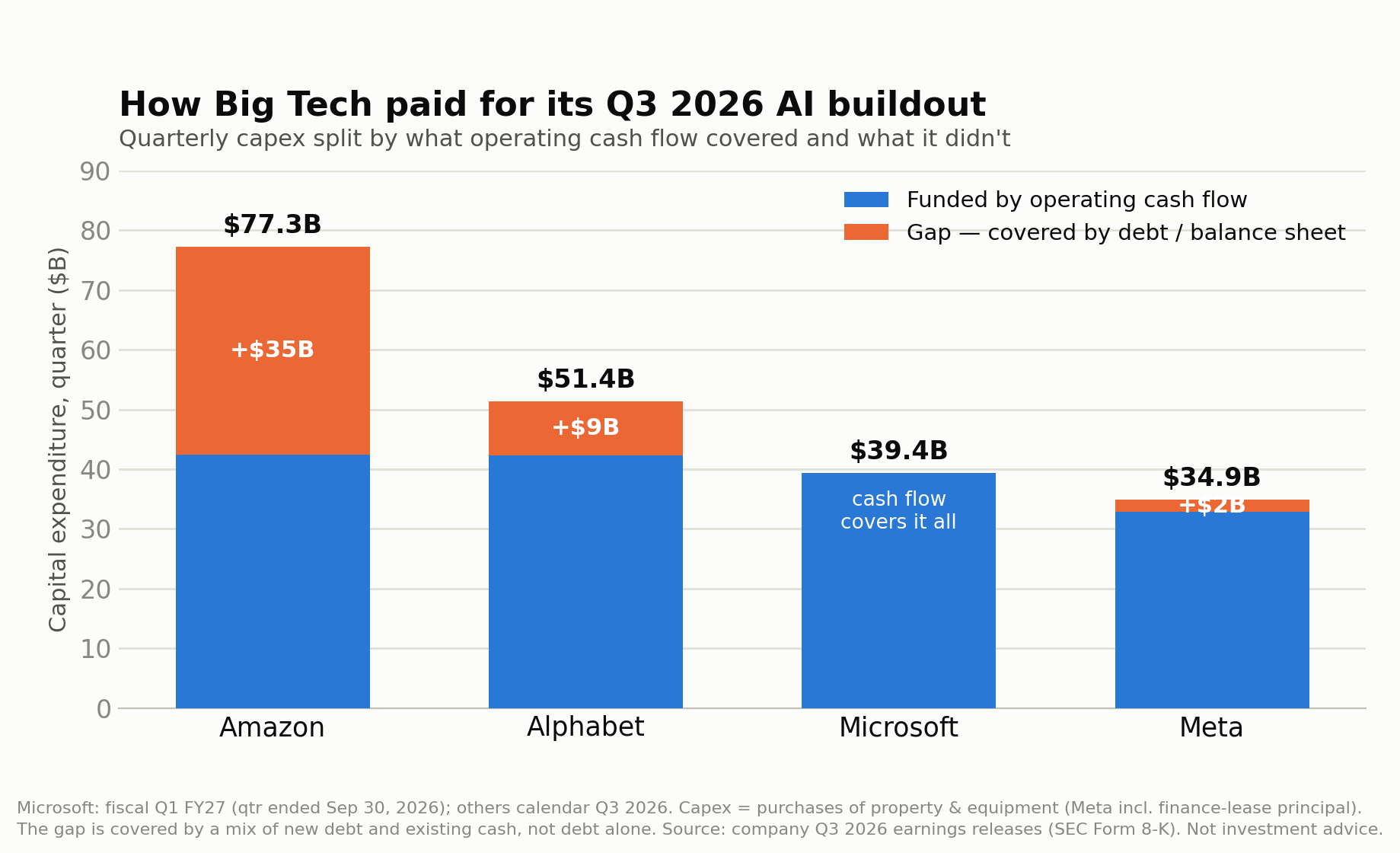
The chart above shows the split. Microsoft is the one still paying its own way. Amazon, Alphabet and Meta each outspent their operating cash flow and leaned on the balance sheet to cover the difference.
How to Read This Ledger
- Public companies (Microsoft, Alphabet, Amazon, Meta, Oracle): every capex, cash-flow and debt figure comes from the company's own quarterly earnings release filed on SEC Form 8-K.
- Private labs (OpenAI, Anthropic, xAI): these companies file nothing publicly. Their figures come from the companies' own statements or financial press, and we label them as reported or estimated. Treat them as directional, not exact.
- One quarter, two calendars: Microsoft's quarter is its fiscal Q1 2027, ended September 30, 2026. Oracle runs on a May fiscal year, so its most recent reported quarter ended August 31, 2026. The other three are calendar Q3 2026.
The Hyperscalers
Microsoft: Funding It From Cash
Microsoft spent $39.4 billion on property and equipment in the quarter ended September 30, 2026, roughly double the $19.4 billion of a year earlier. What sets it apart is how it paid. Operating cash flow was $58.0 billion, comfortably more than capex. Microsoft took on no new debt in the quarter and repaid about $4.85 billion, and its long-term debt stands at a modest $31.1 billion.
One nuance: the $39.4 billion is the cash purchases of property and equipment line and excludes finance leases. Microsoft's July guidance pointed to capex above $50 billion including leases. A fiscal 2027 accounting change, which extended data-center useful lives from 15 to 25 years and classified more leases as operating rather than finance, lowers the reported figure. The smaller number reflects an accounting shift, not a spending cut.
Debt-funded? No. Microsoft funded the quarter from cash flow and reduced net debt.
Alphabet: Record Spend, and Back Into the Bond Market
Alphabet's capex reached $51.4 billion in Q3 2026, up from $24.0 billion a year earlier, the second-largest quarterly figure in the group after Amazon. The top line was strong as well: revenue of $127.6 billion, net income of $26.5 billion, and Google Cloud revenue up 103 percent to $30.7 billion.
Capex still outran cash generation. Operating cash flow was $42.3 billion, so free cash flow was roughly negative $9.1 billion for the quarter. Alphabet bridged the gap by issuing $28.7 billion of senior unsecured notes, net, during the quarter. Long-term debt has climbed to $125.1 billion from $46.5 billion at the end of 2025, an increase of nearly $79 billion in nine months. Full-year 2026 capex guidance stands at roughly $195 billion to $205 billion, and management has signaled that 2027 spending will rise significantly. In early November Alphabet returned to the market with a seven-part euro bond of about 6 billion euros, and it reports about $130.5 billion of future data-center lease payments that sit off its balance sheet (both reported).
Debt-funded? Increasingly. Alphabet is still a cash machine, but it is now running a capex deficit and financing it with bonds.
Amazon: The Biggest Number, and the Biggest Borrower
Amazon posted the quarter's largest figure: $77.3 billion of capex in three months, up from $35.1 billion a year earlier, and $215.2 billion over the trailing twelve months. Management reaffirmed full-year 2026 cash capex of about $220 billion.
Operating cash flow was $42.4 billion for the quarter, a little more than half of capex, so Amazon turned to debt in size, issuing $48.1 billion of long-term debt in the quarter alone. Its long-term debt has grown to $173.1 billion from $65.6 billion at the end of 2025, up more than $107 billion this year. The underlying business remains healthy, with net sales of $201.9 billion and net income of $20.7 billion, but no company in this group is leaning on borrowed money harder right now.
Debt-funded? Heavily. Amazon is the clearest example of the buildout outrunning cash flow.
Meta: A Small Gap, and a Big One Kept Off the Books
Meta's capex was $34.9 billion for Q3 2026, including finance-lease principal. Against operating cash flow of $32.8 billion, that is a modest free-cash-flow deficit of about $2.1 billion, small next to Amazon or Alphabet. Full-year 2026 capex guidance was narrowed to $135 billion to $145 billion.
The more interesting money is the part that is not on Meta's balance sheet. Its Hyperion data center in Louisiana is being built through a joint venture with Blue Owl Capital, in which Blue Owl-managed funds own roughly 80 percent and Meta about 20 percent. The project is financed largely with a bond issuance reported at more than $27 billion, backed by the data-center assets. Meta leases the facility back and provides a residual-value guarantee, which keeps that debt off its own books. On the balance sheet, Meta has raised about $24.9 billion of long-term debt so far in 2026, lifting the total to $80.9 billion. In early November Meta was reported to be weighing at least $20 billion of new dollar and euro bonds, which would be its first debt issue in euros (reported).
Off-balance-sheet leasing is an industry pattern. Moody's has counted roughly $662 billion of data-center leases signed but not yet commenced across the five public names, a parallel buildout nearly as large as the one on the balance sheets (reported).
Debt-funded? Yes, some on the balance sheet and more beside it. The special-purpose vehicles are the thing to watch.
Oracle: The Order Book Everyone Is Watching
Oracle sits on a different calendar. Its most recent reported quarter ended August 31, 2026, with capex of $28.5 billion. Oracle funded that quarter with $20 billion of equity through an at-the-market program and repaid about $4.2 billion of debt rather than issuing new bonds. That restraint did not last: in early November Oracle filed to raise $10 billion of new shares and $10 billion of senior notes, with the notes reportedly pricing at coupons of 7 percent to 8.65 percent, a telling cost of money for the group's most aggressive builder (reported).
The number that matters for this series is the backlog. Oracle's remaining performance obligations reached $664 billion, up $209 billion year over year, after it booked more than $30 billion of new AI cloud contracts in the quarter. Oracle's filing does not name customers, but press reports attribute roughly half of that backlog to a single customer, OpenAI. That makes Oracle the hinge between the hyperscaler spending above and the purchase commitments below. The share attributed to OpenAI is reported, not disclosed by Oracle.
The Money That Has Already Been Promised
Spending is only half the story. The other half is commitments: multi-year deals in which one company has agreed to pay another for compute, chips or cloud capacity. OpenAI sits at the center of almost all of them. The confirmed and reported dollar deals:
- OpenAI and Oracle: about $300 billion of cloud capacity over roughly five years, part of the $500 billion Stargate program and tied to 4.5 gigawatts of capacity (reported).
- OpenAI and Microsoft Azure: an incremental $250 billion of Azure commitments, disclosed in Microsoft's own 10-Q (confirmed).
- OpenAI and Nvidia: up to $100 billion as Nvidia invests and OpenAI deploys at least 10 gigawatts of systems (letter of intent, an up-to figure).
- OpenAI and Amazon Web Services: $38 billion over seven years (confirmed in a joint announcement).
- OpenAI and CoreWeave: about $22 billion cumulative across three expansions (confirmed in CoreWeave filings).
Two more deals are real but capacity-based, with no disclosed dollar value: AMD, for about 6 gigawatts of GPUs plus warrants for up to roughly 160 million AMD shares, and Broadcom, for about 10 gigawatts of custom accelerators. Anthropic has its own commitments: up to one million Google TPUs, more than a gigawatt of capacity valued in the tens of billions of dollars, and Amazon's Project Rainier Trainium supercomputer, backed by roughly $8 billion of Amazon investment.
The Catch: These Numbers Do Not Add Up Cleanly
OpenAI's chief executive has described roughly $1.4 trillion of commitments over about eight years, tied to around 30 gigawatts of compute. That is the broadest single figure, and it needs careful handling for one structural reason: the same compute gets counted more than once. Nvidia invests in OpenAI, OpenAI contracts for cloud capacity from Oracle, CoreWeave, AWS and Azure, and those clouds order Nvidia chips. The same gigawatts appear as a chip order and as a cloud contract, so summing every announced number overstates the true new spending. Some analysts have flagged that this circularity can make demand look larger than it is, while OpenAI's leadership argues the scale reflects real demand. Either way, any headline trillion-dollar total is a gross tally of overlapping promises, not net cash out the door.
The Private Frontier Labs
These three companies file nothing publicly. Everything in this section is reported or estimated, and it describes the shape of things rather than audited fact.
OpenAI: Spending the Most, Borrowing Through Others
There is no clean budget number, but the markers are large. Compute-spend targets through 2030 have been reported in a range of $600 billion to $750 billion, Citi models roughly $1.3 trillion, and OpenAI itself cites about $1.4 trillion of commitments. A reported revenue run-rate of roughly $70 billion by late 2026 is growing fast but is a fraction of what has been promised.
On equity, OpenAI's latest round came in smaller than planned. It was reportedly cut to about $20 billion at a valuation near $1.25 trillion, below the roughly $1.4 trillion it first sought, with about $11 billion closed by early November. That followed a $122 billion raise at an $852 billion valuation earlier in 2026 (all reported).
The financing structure is the interesting part: OpenAI itself has taken on relatively little direct debt. The borrowing sits with its partners and in special-purpose vehicles, an estimated $100 billion carried by Oracle, SoftBank and CoreWeave, plus project-level deals such as the $15 billion Abilene, Texas campus developed by Crusoe and Blue Owl and about $38 billion of JPMorgan-led term loans for Stargate sites. SoftBank issued about $11 billion of speculative-grade bonds in late 2026 to fund an OpenAI equity tranche. OpenAI is the anchor tenant, and the debt belongs to other people.
Anthropic: The Equity-Funded Exception
Anthropic has the cleanest balance sheet of the three. It raised about $65 billion at a $965 billion post-money valuation in its Series H in May 2026 and carries little or no reported debt of its own. Its compute sits on partners' books: an October 2025 Google Cloud agreement for up to one million TPUs, and Amazon as its primary training partner with about $8 billion invested and the Trainium-based Project Rainier. Its reported revenue run-rate topped $65 billion by the end of July 2026, coincidentally the same figure as its raise but an entirely different measure. Anthropic has reportedly filed confidentially for an IPO.
xAI: The Most Leveraged, and the Least Transparent
xAI leans hardest on debt. Its reported raise of about $20 billion split roughly into $7.5 billion of equity and $12.5 billion of debt, including a vehicle that acquires Nvidia chips and leases them back to xAI for its Colossus 2 supercomputer in Memphis, a textbook chip-vendor financing structure. Morgan Stanley earlier arranged $5 billion of secured debt alongside $5 billion of equity. Colossus 2 is targeting about one million GPUs, with the total buildout estimated at $35 billion to $40 billion. xAI's actual revenue is unresolved in the reporting, with estimates ranging from a few hundred million dollars to a couple of billion, so we are not putting a number on it.
The Ledger in One Line
Microsoft is still paying from its own cash flow. Alphabet and Meta have returned to the bond market and placed part of the cost in off-balance-sheet vehicles. Amazon is borrowing tens of billions of dollars a quarter. Underneath it all sits roughly $1.4 trillion of promised compute that, once its double counting is netted out, frames the real question hanging over the boom: not whether the money is being spent, but whether the demand will be there to pay it back.
Q3 2026 by the Numbers
- Amazon capex: $77.3 billion, against operating cash flow of $42.4 billion; $48.1 billion of long-term debt issued
- Alphabet capex: $51.4 billion, against operating cash flow of $42.3 billion; $28.7 billion of notes issued
- Microsoft capex: $39.4 billion, against operating cash flow of $58.0 billion; no new debt
- Meta capex: $34.9 billion, against operating cash flow of $32.8 billion; Hyperion financed off balance sheet
- Oracle capex: $28.5 billion (quarter ended August 31); remaining performance obligations of $664 billion
- Bonds issued by the five public names in 2026 through November 9: about $296 billion (reported)
- OpenAI's stated compute commitments: about $1.4 trillion over roughly eight years (gross, with overlap)
We will update the ledger every quarter. Every public-company figure here comes from Q3 2026 earnings releases filed with the SEC. Private-company figures are reported or estimated and labeled as such.