AbbVie Earnings: How to Read ABBV's Quarterly Results
Key Numbers
Revenue: $17.4B
EPS: $3.82
Revenue Growth: +10.5%
How to Read an AbbVie Earnings Release
AbbVie (ABBV) reported Q3 2026 total net revenues of $17.4 billion, beating expectations by $200 million and reflecting operational revenue growth of more than 10%. Adjusted earnings per share came in at $3.82, $0.07 above the guidance midpoint. Those two figures, revenue and adjusted EPS, are the standard entry point for evaluating any quarterly ABBV release.
AbbVie organizes its business into four segments: immunology, neuroscience, oncology, and aesthetics. Each segment carries different growth dynamics and responds to different market forces. Reading ABBV earnings means tracking each segment's trend line, not just the consolidated total.
The Immunology Segment: Two Speeds, One Number
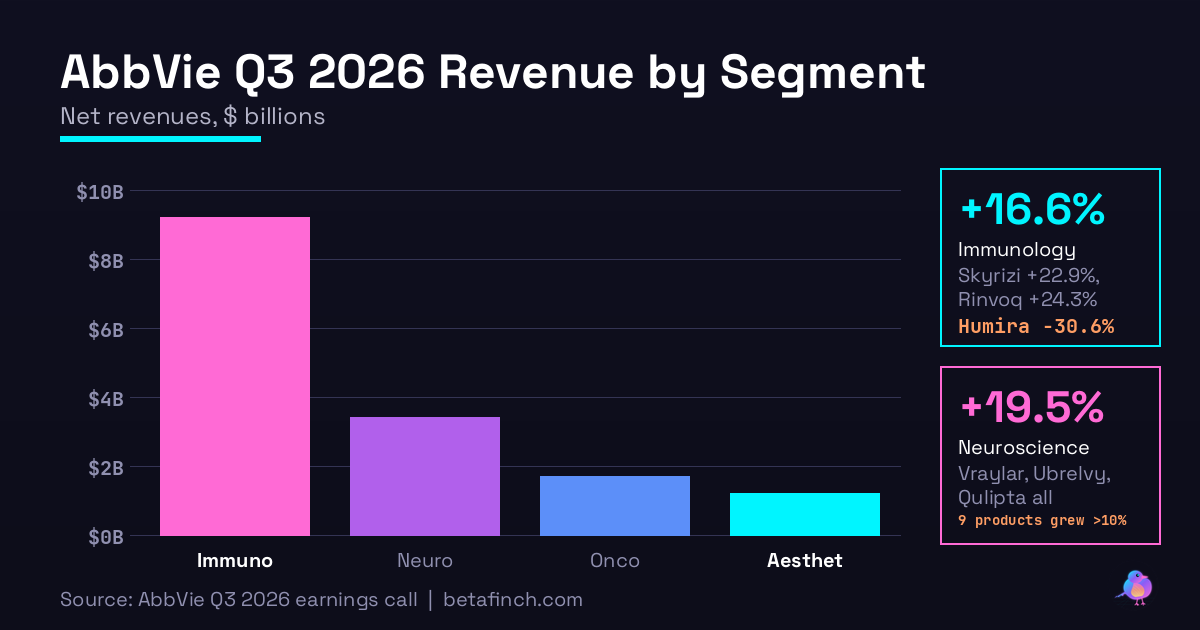
Immunology is the largest segment and the central story in AbbVie's current transition. The segment delivered total revenues approaching $9.2 billion in Q3 2026, reflecting operational sales growth of 16.6%. The headline number contains two very different trajectories running in parallel.
Skyrizi posted total sales of nearly $5.8 billion in Q3 2026, up 22.9% on an operational basis. Rinvoq delivered global sales of $2.7 billion, reflecting operational growth of 24.3%. These two drugs are AbbVie's primary immunology growth engines, with active approvals spanning plaque psoriasis, Crohn's disease, ulcerative colitis, and rheumatoid arthritis.
Humira global sales were $683 million in Q3 2026, down 30.6% on an operational basis, reflecting continued biosimilar competition. The biosimilar market entry began in 2023 and the erosion is ongoing. When reading AbbVie's immunology results, the Humira line functions as a drag quantifier; the central question each quarter is how much the Skyrizi and Rinvoq growth rate offsets the Humira decline. In Q3 2026, the net result was 16.6% operational growth for the immunology segment as a whole.
Beyond Immunology: Neuroscience, Oncology, and Aesthetics
Neuroscience total revenues reached nearly $3.4 billion in Q3 2026, up 19.5% on an operational basis. The segment includes Botox Therapeutic, Vraylar, and migraine-focused products including Qulipta and Ubrelvy. At 19.5% growth, neuroscience has established itself as a meaningful second growth axis alongside immunology, and the segment's rate approached the immunology growth figure for the first time.
Oncology segment revenue was $1.7 billion in Q3 2026. The portfolio centers on hematologic cancers, with Venclexta and Imbruvica as the primary products. The oncology segment faces distinct lifecycle dynamics; Imbruvica operates in a competitive drug class, while pipeline additions carry earlier commercial timelines. Pipeline candidates carry particular weight for the forward outlook in this segment; etentamig, an oncology asset with a potential approval timeline in 2027, would add a new product line to the franchise.
Aesthetics segment revenue was $1.2 billion in Q3 2026, with Botox Cosmetic and Juvederm as the principal products. Aesthetics tends to be the most macroeconomically sensitive part of AbbVie's portfolio, as elective procedure volumes reflect discretionary consumer spending. Seasonal patterns apply here, with Q4 historically generating stronger aesthetics volumes than Q3.
Across all four segments, 9 key products delivered double-digit growth in Q3 2026. That breadth provides important context for the total revenue figure; growth is distributed across the portfolio rather than concentrated in a single product cycle.
Reading Guidance Raises
Management guidance revisions are one of the more direct signals in any pharma earnings release. For Q3 2026, AbbVie raised its full-year revenue guidance to $67.8 billion, an increase of $200 million. This was the third guidance raise of the year, bringing the cumulative upward revision to $800 million since the start of 2026.
A single guidance raise can reflect a one-time beat or favorable quarterly timing. Three raises within the same fiscal year, totaling $800 million cumulatively, reflects sustained outperformance relative to the company's own planning assumptions. The cumulative magnitude also carries weight: an $800 million increase on a $67.8 billion base represents roughly 1.2% of upward revision, which is meaningful in a large-cap pharmaceutical context where guidance ranges tend to be narrow. When evaluating a pharmaceutical earnings release, tracking the number and cumulative size of guidance revisions across the year provides a longitudinal view into execution consistency that any single quarterly beat cannot convey on its own.
Gross margin was 85.1% and operating margin came in at 48.7% in Q3 2026. High gross margins are characteristic of biologic drug portfolios, where manufacturing costs represent a relatively small share of revenue. Tracking these margins quarter to quarter helps gauge whether the Skyrizi and Rinvoq revenue ramp is converting efficiently to operating income.
Dividend and Free Cash Flow
AbbVie announced a 5.2% increase in its quarterly cash dividend to $1.82 per share alongside Q3 2026 results. The company noted that this represents more than 350% growth in the quarterly dividend since inception. The dividend increase is a direct output of the sustained free cash flow generation that the biologics franchise has maintained through the Humira transition.
Free cash flow through the first nine months of 2026 was $14 billion. That figure covers the period during which Humira biosimilar erosion has been most acute, alongside significant ongoing commercial and R&D investment in Skyrizi and Rinvoq. Sustaining $14 billion in nine-month free cash flow under those conditions reflects the structural cash generation capacity of the existing portfolio.
For readers analyzing the balance sheet, the nine-month free cash flow total and the dividend track record are the two figures that measure AbbVie's ability to sustain capital returns across the pharma product lifecycle, independent of any single drug's patent status.
What to Watch in Future Quarters
Several pipeline and commercial milestones frame the forward read on ABBV's quarterly results. Pipeline progress does not appear directly in quarterly revenue lines, but it determines the trajectory of future segment figures, and the milestone calendar is worth tracking alongside financial results.
Etentamig, an oncology candidate, carries a potential approval timeline in 2027, which would add a new product to the oncology segment's revenue base. Rinvoq has additional dermatology indications in development; regulatory outcomes in this area would expand the drug's approved market beyond current rheumatology and gastrointestinal approvals. The Skyrizi subcutaneous induction formulation ramp is an active commercial story, as adoption of the subcutaneous delivery route is expected to drive incremental volume growth within the existing indication set.
Each of these milestones, if executed, shifts the revenue mix in ways that would appear in subsequent immunology and oncology segment figures. Tracking pipeline progress ahead of an earnings release provides context for whether a quarterly segment result reflects the existing commercial trajectory or a step-change from a new approval or indication expansion.
AbbVie covers all four segments and the full financial results in detail in its quarterly earnings podcast. The [AbbVie Q3 2026 earnings podcast](/podcasts/ABBV_Q3_2026) is available to listen now. For broader context on sector trends, [healthcare sector earnings](/groups/healthcare) aggregates comparable releases across pharma and biotech.
Key Numbers at a Glance
- Q3 2026 total net revenues: $17.4 billion, up 10.5% operationally
- Adjusted EPS: $3.82, $0.07 above the guidance midpoint
- Skyrizi Q3 sales: $5.8 billion, up 22.9% operationally
- Rinvoq Q3 sales: $2.7 billion, up 24.3% operationally
- Humira Q3 sales: $683 million, down 30.6% operationally
- Immunology segment revenue: $9.2 billion, up 16.6% operationally
- Neuroscience segment revenue: $3.4 billion, up 19.5% operationally
- Oncology segment revenue: $1.7 billion
- Aesthetics segment revenue: $1.2 billion
- Full-year revenue guidance: $67.8 billion (third raise of 2026, $800 million cumulative increase)
- Quarterly dividend: $1.82 per share, up 5.2% (more than 350% growth since inception)
- Nine-month free cash flow: $14 billion