Apple's Net Cash Position: What the Balance Sheet Shows
What Net Cash Means and Apple's Current Figure
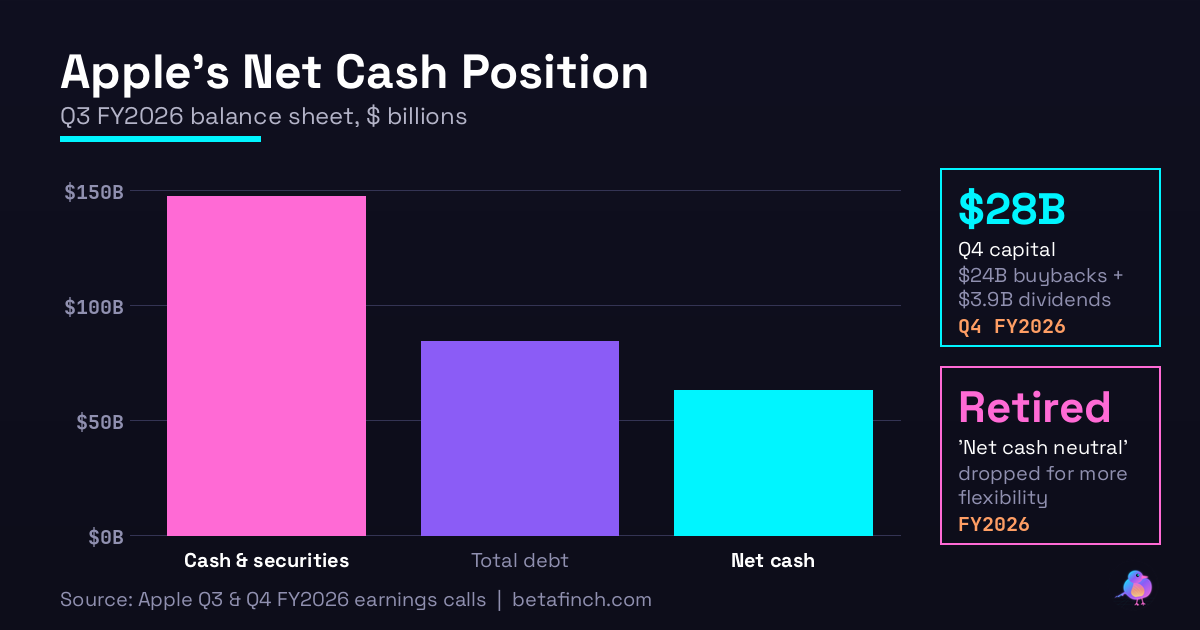
Net cash is a straightforward balance-sheet metric: total cash and marketable securities minus total debt. For Apple (AAPL), that calculation produces a figure of roughly $63 billion as of the company's third fiscal quarter of 2026. Apple ended that quarter with $147 billion in cash and marketable securities against $84 billion in total debt, yielding the approximately $63 billion net cash position.
The gap between cash assets and debt obligations represents the company's financial cushion above and beyond what it owes. Net cash is distinct from free cash flow, which measures cash generated in a period, and from gross cash, which ignores debt entirely. The net figure captures the actual surplus available for strategic deployment, shareholder returns, or balance-sheet management.
Why the Number Matters
Net cash serves as the foundation of Apple's capital-return program. When a company carries a large net cash position, it has latitude to repurchase shares, raise dividends, or pursue acquisitions without first accessing debt markets. For Apple, the $63 billion figure as of Q3 FY2026 provides context for understanding the scale and sustainability of its repurchase activity.
Net cash also functions as a measure of financial flexibility. Companies with net debt, where total debt exceeds cash, face a different set of constraints than those with a net cash surplus. Apple has maintained a net-cash position for years, though the size of that surplus has declined substantially as the company has distributed capital to shareholders at scale.
The Policy Shift: Dropping Net Cash Neutral
The most significant development in Apple's capital-allocation strategy in fiscal 2026 was the official retirement of its long-standing "net cash neutral" policy. That policy committed the company to drawing down its net cash position until cash and debt roughly balanced. In practical terms, it meant Apple was directing its cash generation toward repurchases and dividends rather than accumulating a large cash pile.
In fiscal 2026, Apple officially dropped that goal, giving itself more flexibility on the balance sheet. The retirement of net cash neutral does not mean the company will stop returning cash to shareholders. It means Apple no longer targets a specific net cash level as the endpoint of its capital-return program. The company can now calibrate returns based on market conditions, strategic opportunities, and operating cash flow, rather than working toward a predetermined balance-sheet ratio.
The change has meaningful implications for how Apple manages future capital allocation. Under the old framework, every dollar of net cash above zero represented a pending return to shareholders, creating an implicit floor on repurchase activity. Under the new framework, Apple retains discretion over how much net cash to carry on the balance sheet, which creates more room to adjust the pace and form of capital returns over time.
Capital Return in Practice
The numbers from Apple's two most recent fiscal quarters illustrate the scale of its shareholder return program. In the fourth fiscal quarter of 2026, Apple returned $28 billion to shareholders, split between $24 billion in share repurchases and $3.9 billion in dividends. The company declared a quarterly dividend of $0.27 per share in that quarter.
The third fiscal quarter of 2026 produced even larger capital returns: $33 billion in total, including $25.8 billion in share repurchases and $4 billion in dividends and equivalents. Together, those two quarters account for more than $61 billion returned to shareholders in the second half of fiscal 2026 alone.
Share repurchases reduce Apple's outstanding share count over time, which raises earnings per share mechanically and returns value to continuing shareholders. Dividends distribute cash directly. The combination at this scale reflects both the volume of cash Apple generates and the company's consistent prioritization of returning that cash to shareholders.
The Cash-Generation Engine
The figures above are sustainable only because Apple generates cash at a matching scale. In the fourth quarter of fiscal 2026, the company produced a record $28.1 billion in operating cash flow. That single-quarter figure approaches the full net cash position, illustrating how quickly Apple can replenish its balance sheet even while distributing tens of billions to shareholders each quarter.
The underlying driver of that cash generation is Apple's installed base and services ecosystem. Apple's active installed base exceeded 2.5 billion devices, supported by 1.5 billion paid subscriptions. That combination of hardware loyalty and subscription economics creates a recurring revenue stream that is relatively insensitive to any single product cycle or macroeconomic quarter.
Apple's fourth-quarter fiscal 2026 revenue reached $114.5 billion, up 12% year over year, reinforcing the top-line growth that feeds the operating cash flow figure. Beta Finch's full Apple earnings coverage, including the Q3 and Q4 fiscal 2026 calls, is available at /groups/AAPL.
Reading the Balance Sheet Going Forward
The Q3 fiscal 2026 balance sheet, with $147 billion in cash and marketable securities and $84 billion in debt, represents the most recently quantified snapshot of Apple's net cash position based on earnings-call disclosures. The Q4 fiscal 2026 earnings call did not provide an updated cash or debt figure; the full balance sheet from that quarter will appear in Apple's annual report (10-K). Readers looking for the latest balance-sheet data can reference Apple's most recent 10-K filing for complete cash, debt, and equity figures as of the fiscal year end.
With the net cash neutral policy retired, the central question for future reporting periods is how Apple deploys its expanded balance-sheet flexibility. The company could direct cash toward repurchases at a faster or slower pace, pursue strategic acquisitions, or allow the net cash position to grow if operating cash flow outpaces distributions. Apple has not guided to a specific net cash target going forward, leaving the allocation framework more open-ended than it was under the neutral policy.
Key Figures at a Glance
- Net cash position (Q3 FY2026): approximately $63 billion, from $147 billion in cash and marketable securities minus $84 billion in total debt.
- Net cash neutral policy: officially retired in fiscal 2026, removing the prior balance-sheet target.
- Q4 FY2026 capital returned: $28 billion, comprising $24 billion in repurchases and $3.9 billion in dividends at $0.27 per share quarterly.
- Q3 FY2026 capital returned: $33 billion, comprising $25.8 billion in repurchases and $4 billion in dividends and equivalents.
- Q4 FY2026 operating cash flow: $28.1 billion, a record for the quarter.
- Installed base: more than 2.5 billion active devices with 1.5 billion paid subscriptions.
- For the most current balance-sheet data, Apple's 10-K is the authoritative source.