Robinhood (HOOD) Q3 2026 Earnings: Record Revenue and Net Deposits
Robinhood Markets (HOOD) posted Q3 2026 revenue of $1.4 billion, up 12% year-over-year, marking a new quarterly record for the company. Adjusted EBITDA reached $808 million, a 9% gain year-over-year, translating to an adjusted EBITDA margin of 57%.
GAAP earnings per share for the quarter came in at $0.51. Alongside these results, Robinhood introduced a new adjusted EPS metric of $0.60, designed to exclude mark-to-market movements on Robinhood Ventures portfolio investments. Management characterized the new figure as a cleaner representation of operational earnings, given the growing complexity of the company's venture book and the volatility that unrealized investment changes can introduce to period-over-period GAAP comparisons.
Key Numbers
Revenue: $1.4B
EPS: $0.51
Revenue Growth: +12%
Trading Volume Accelerates Across Asset Classes
Trading activity across Robinhood's core asset classes accelerated sharply in Q3 2026. Equities, options, and margin trading volumes each grew approximately 50% year-over-year, reflecting both a more active retail environment and continued platform engagement from the company's expanding user base. The margin volume figure is particularly notable because margin lending directly contributes to net interest income, creating a revenue feedback loop alongside the trading volume gains.
Event contracts, Robinhood's prediction market product tied to elections, economic data, and sports outcomes, grew 7x year-over-year. That growth rate significantly outpaced the broader trading volume expansion and signals that event contracts are moving from novelty to meaningful contributor to transaction-based revenue. The 7x figure represents one of the fastest organic growth rates across any Robinhood product category and positions the segment as a potential standalone revenue driver in future quarters.
Revenue Diversification: 14 Streams at Scale
As of Q3 2026, 14 separate revenue streams have each reached $100 million or more in annualized revenue. The company's total annualized revenue run rate now exceeds $5.5 billion. That diversification represents a significant structural shift; in prior years, a single category, options payment-for-order-flow, accounted for the majority of revenue, leaving the business highly sensitive to trading volume swings in one asset class.
The revenue mix now spans transaction-based income from equities, options, and crypto; net interest income from margin lending and cash sweep programs; and subscription and services revenue. Banking products and credit card offerings remain in limited rollout.
Net Deposit Strength Exceeds Full-Year Target
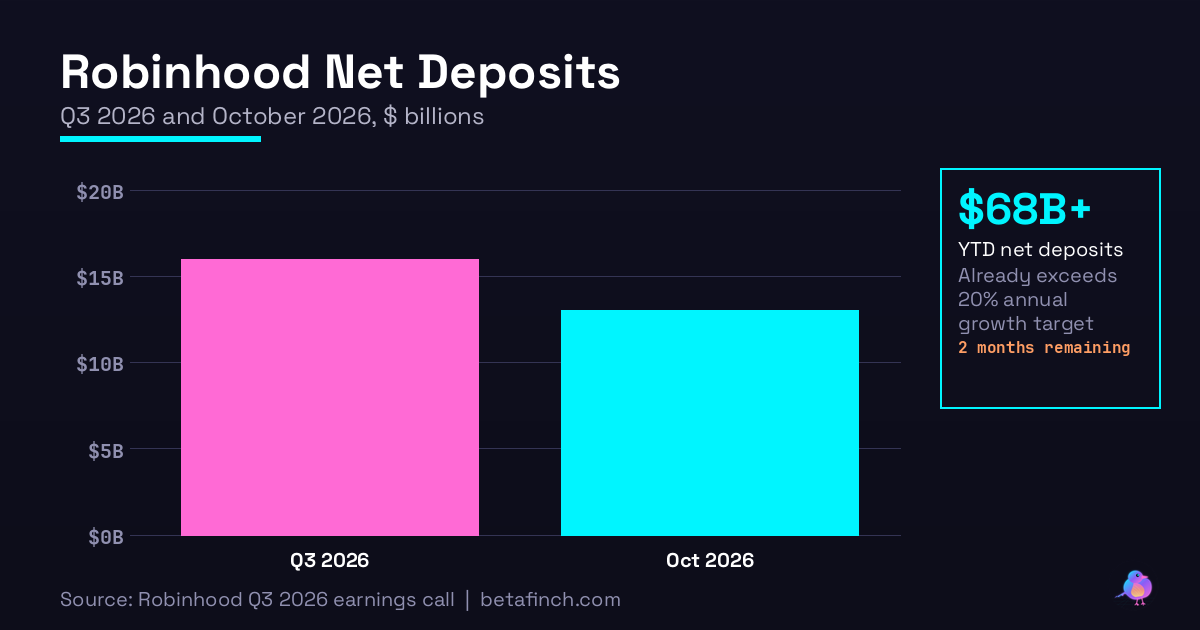
Robinhood posted $16 billion in net deposits during Q3 2026 alone. Year-to-date net deposits through the end of September exceeded $68 billion, surpassing the company's 20% annual net deposit growth target with two full months remaining in the fiscal year. The 20% target, calculated on the prior year's total assets, implied a dollar figure that Robinhood cleared by a significant margin well ahead of the December 31 year-end.
That pace of asset gathering has direct implications for net interest income and future revenue potential, since larger assets under custody translate to larger cash sweep balances and margin loan opportunities. Platform assets stood at nearly $400 billion at the end of Q3 2026, reflecting both net deposit inflows and market appreciation across existing equity positions. The scale of that asset base places Robinhood among the larger retail brokerage platforms by assets, even as it continues to target a younger demographic than many traditional wealth management firms.
October Deposits and the Dell Family Inflow
October 2026 net deposits exceeded $13 billion, extending the momentum from Q3 2026. That figure included approximately $6 billion from the Dell family's gift to Trump accounts, a large, non-recurring charitable transfer that management disclosed separately to contextualize the month's elevated inflow.
Excluding the Dell family inflow, underlying October deposit activity remained above typical monthly run rates, suggesting organic momentum continued into the fourth quarter. Management noted the milestone without quantifying an exact organic figure but characterized the broader deposit environment as favorable, leaving detailed segmentation to future disclosures.
Adjusted EPS: A New Profitability Lens
The Q3 2026 results introduced adjusted EPS as a formal metric. At $0.60, it exceeded GAAP EPS of $0.51 by $0.09. The gap reflects mark-to-market changes in the Robinhood Ventures investment portfolio, which can swing materially in either direction depending on market conditions for private technology companies. The company described the adjustment as consistent with how management evaluates period-over-period operational performance, independent of unrealized gains or losses in the venture book.
The 57% adjusted EBITDA margin at $808 million in absolute EBITDA provides another frame for the company's operational profitability. At a $1.4 billion quarterly revenue base, that margin level indicates Robinhood is generating significant cash flow relative to its scale, particularly given the ongoing investment in new products and international expansion.
Robinhood Chain: First-Quarter Metrics
Robinhood Chain, the company's layer-2 blockchain network, launched on mainnet on July 1, 2026. In its first full quarter of operation, the chain processed over $100 billion in decentralized exchange (DEX) volume and generated over $50 million in chain fees.
Those figures arrive at an early stage of the network's lifecycle and are partly influenced by Robinhood's own crypto trading product routing volume through the chain. Even adjusting for internal flows, the $50 million in chain fees represents real protocol revenue, distinguishing Robinhood Chain from many layer-2 networks that generate volume without monetizable fee capture.
Global Expansion and the Dubai Authorization
Alongside the Q3 results, Robinhood disclosed authorization from the Dubai Financial Services Authority (DFSA), extending the company's regulatory footprint into the Gulf Cooperation Council region. The Dubai approval joins a growing list of international licenses and represents a continued effort to diversify the user base beyond North America. International expansion also opens access to additional net deposit pools and trading volumes that could contribute to the company's long-term revenue run rate.
Q3 2026 at a Glance
For a full breakdown of Robinhood's Q3 2026 results, including management commentary on the platform roadmap and deposit growth trajectory, the Beta Finch earnings podcast covers the call in detail. The full episode is available at betafinch.com/podcasts/hood.
- Revenue: $1.4 billion, +12% year-over-year, a new quarterly record
- Adjusted EBITDA: $808 million, +9% year-over-year, 57% margin
- Adjusted EPS: $0.60; GAAP EPS: $0.51
- Platform assets: nearly $400 billion
- Q3 net deposits: $16 billion; year-to-date through September: $68 billion+, exceeding the 20% annual growth target
- October 2026 net deposits: $13 billion+, including $6 billion from the Dell family gift to Trump accounts
- 14 revenue streams at $100 million+ annualized; total annualized run rate over $5.5 billion
- Equities, options, and margin trading volumes each up approximately 50% year-over-year
- Event contracts up 7x year-over-year
- Robinhood Chain: $100 billion+ in DEX volume, $50 million+ in chain fees since July 1 launch