Boeing Q3 2026 Earnings: Record Backlog and Path to $10B Free Cash Flow
Key Numbers
Revenue: $24.2B
Revenue Growth: +4%
FCF: $464M
Commercial Deliveries Hit an Eight-Year High
Boeing (BA) delivered 161 commercial aircraft in Q3 2026, the highest quarterly total since 2018, marking a tangible inflection in the company's post-crisis production recovery. Total backlog reached a record $745B at quarter end, underpinned by more than 6,300 commercial aircraft on order, reinforcing demand visibility across multiple delivery cycles. That backlog figure represents roughly eight years of production at current run rates, providing revenue certainty that shapes Boeing's multiyear investment and workforce planning.
Q3 Financial Results
Q3 2026 revenue came in at $24.2B, up 4% year over year. Free cash flow turned positive at $464M for the quarter, an improvement from the prior-year period, while operating margin reached 1.5%. The revenue gain reflected higher commercial delivery volume and defense segment growth, partially offset by ongoing program execution costs.
Boeing Commercial Airplanes (BCA) anchors the revenue mix with a segment backlog of $612B covering more than 6,300 aircraft, itself a record. Boeing Global Services (BGS) reported $5.6B in quarterly revenue at an 18.3% operating margin, the highest margin among the three segments, driven by aftermarket parts and maintenance contracts that scale with the size of the installed fleet. Boeing Defense, Space and Security (BDS) reported $7.9B in Q3 revenue, up 15% year over year, with a segment backlog of $101B, also a record.
Free Cash Flow Roadmap: $2B to $10B
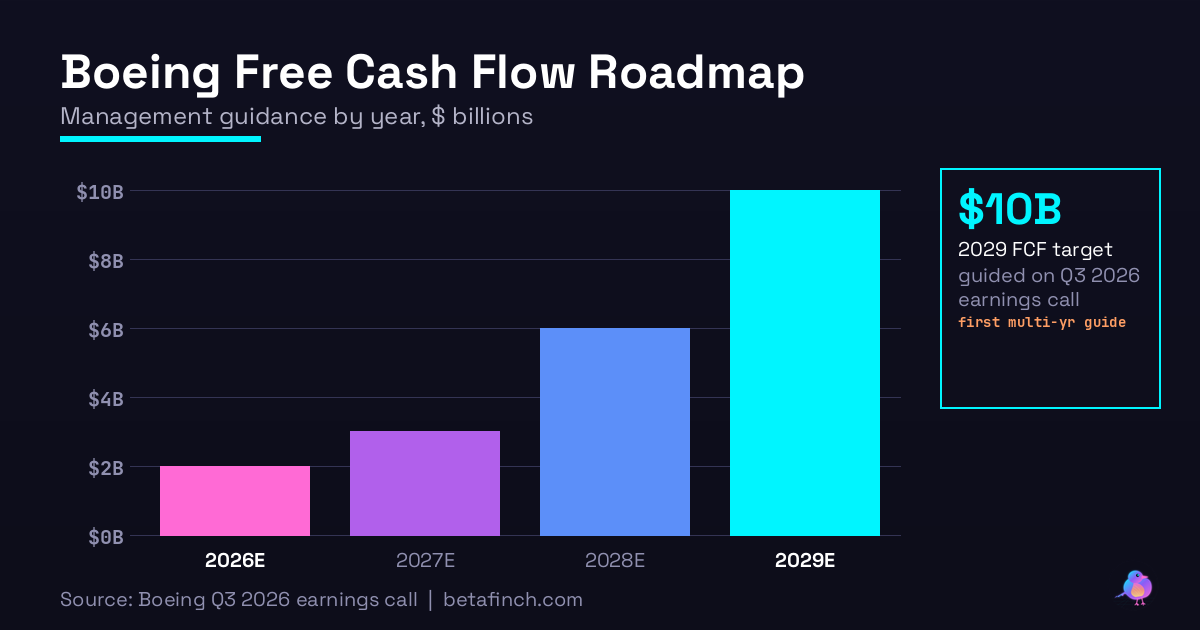
Boeing provided a four-year free cash flow outlook: approximately $2B in 2026, $3B in 2027, $6B in 2028, and $10B in 2029. The stepped cadence reflects production rate increases that unlock operating leverage once each rate tier stabilizes. Each ramp milestone also reduces the working capital drag from aircraft held in work-in-process inventory, compounding the cash flow improvement.
The $2B 2026 figure incorporates current rate constraints, primarily on the 737 program. The step to $3B in 2027 is predicated on the 737 reaching rate 47 and holding there consistently. The larger jump to $6B in 2028 assumes the 737 approaching rate 52 and the 787 reaching rate 10 per month. The $10B target in 2029 represents full-rate production across both programs with cumulative cost learning and materially reduced inventory drag, translating volume gains into proportionally larger cash conversion.
737 Program: Certifications Complete, Rate 47 Delayed to 2027
The 737 program delivered 124 aircraft in Q3 2026, the largest contributor to the quarterly commercial total. Boeing confirmed the full-year 2026 target of 500 deliveries will not be met. Rate 47 per month, previously expected to be reached in 2026, has been pushed to 2027 as Boeing prioritizes supply chain stability over an accelerated ramp timeline. The delay extends the gap between the current delivery run rate and the volume assumed in the near-term FCF guidance.
The FAA completed certification for both the 737-7 and 737-10 variants during the quarter. These certifications remove a regulatory overhang that had constrained deliverable configurations for more than two years. With all MAX variants now certified, Boeing can fulfill orders across the full 737 MAX family, simplifying customer delivery scheduling and reducing renegotiation pressure in the BCA backlog.
787 and 777X: Widebody Production Targets
The 787 Dreamliner delivered 22 aircraft in Q3 2026. Boeing is targeting production rate 10 for the program, a step-up that supports the mid-decade free cash flow improvement built into the 2028 guidance. At rate 10, the 787 contributes meaningfully to fixed-cost absorption across the Everett and North Charleston facilities. The 777X program remains on track for first customer delivery in 2027, completing the transition of Boeing's widebody portfolio to current-generation airframes after a certification and development process that extended across several years.
Defense: F/A-XX Selection and a $101B Backlog
The U.S. Navy selected Boeing for the F/A-XX next-generation fighter program, awarding the company exclusive development rights for the sixth-generation carrier-based aircraft intended for both Navy and Air Force service. The selection positions Boeing as the primary developer of a program that is expected to generate decades of production and sustainment revenue. F/A-XX is at an early development phase, so near-term cash contributions are limited, but the contract establishes a long-duration defense revenue stream with no direct domestic competitor on the platform.
BDS revenue increased 15% to $7.9B in Q3, and the segment backlog reached a record $101B. Contract wins during the period included PAC-3 missile defense systems and F-15EX aircraft, broadening the near-term revenue base beyond F/A-XX. The BDS backlog carries a material share of cost-plus development work, which typically generates lower margins than fixed-price production contracts. As F/A-XX and other programs transition toward full-rate production over the coming years, that mix shift is a constructive factor in the multi-year FCF trajectory.
Execution Risks and the Path to Rate 52
The range of outcomes for Boeing's free cash flow trajectory narrows as production stabilizes, but execution risks remain. The 737 rate-47 target, now set for 2027, requires consistent monthly output without further supplier disruptions. Reaching rate 52 in the second half of 2027, as Boeing's guidance implies, compresses the ramp schedule considerably, leaving limited buffer for additional operational setbacks.
The 787 rate-10 target carries similar supply chain dependencies. Vertical integration steps taken since 2024 have reduced single-source exposure in fuselage fabrication, but the broader composite and systems supplier network remains a constraint on ramp velocity. Operating margin of 1.5% in Q3 reflects the gap between current delivery rates and the volume required to fully absorb fixed overhead. As deliveries move toward the cadence implied by the $10B 2029 FCF target, margin expansion becomes the primary driver of incremental cash generation rather than revenue growth alone. The quarterly progression of delivery rates, supplier performance, and inventory normalization will be the most closely watched indicators of whether the roadmap holds.
Key Metrics at a Glance
- Q3 2026 revenue: $24.2B, up 4% year over year
- 161 commercial aircraft delivered in Q3, the most since 2018
- Record total backlog: $745B; BCA backlog: $612B with more than 6,300 aircraft
- Q3 free cash flow: positive $464M
- FCF roadmap: approximately $2B (2026), $3B (2027), $6B (2028), $10B (2029)
- 737 Q3 deliveries: 124 aircraft; full-year 500 target will be missed; rate 47 pushed to 2027
- FAA certification completed for both the 737-7 and 737-10 variants
- F/A-XX next-generation fighter: Boeing selected by the U.S. Navy
- BDS revenue: $7.9B, up 15%; BDS backlog at a record $101B
- 787 delivered 22 aircraft in Q3; rate-10 target in progress; 777X first delivery on track for 2027
For a full breakdown of Boeing's Q3 2026 results, including management commentary on the 737 ramp timeline, defense contract mechanics, and the assumptions behind each FCF step, the [Beta Finch earnings podcast](/podcasts/BA_Q3_2026) covers the quarter in depth. Additional Boeing and aerospace sector coverage is available in the [aerospace analysis section](/groups/aerospace).