JNJ Q3 2026 Earnings: Pharma Strength Masks MedTech Lag
Key Numbers
Revenue: $25.4B
EPS: $2.59
Revenue Growth: +6%
Johnson & Johnson (JNJ) reported Q3 2026 worldwide sales of $25.4 billion, up 6% on an operational basis year over year. The result keeps the company on track to surpass $100 billion in annual revenue for the first time, after management raised full-year guidance to approximately $100.7 billion. Adjusted diluted EPS came in at $2.59, down 6.8% versus Q3 2025, a decline tied to acquisition-related charges rather than deteriorating operating performance.
Segment Divergence: Innovative Medicine Pulls Ahead
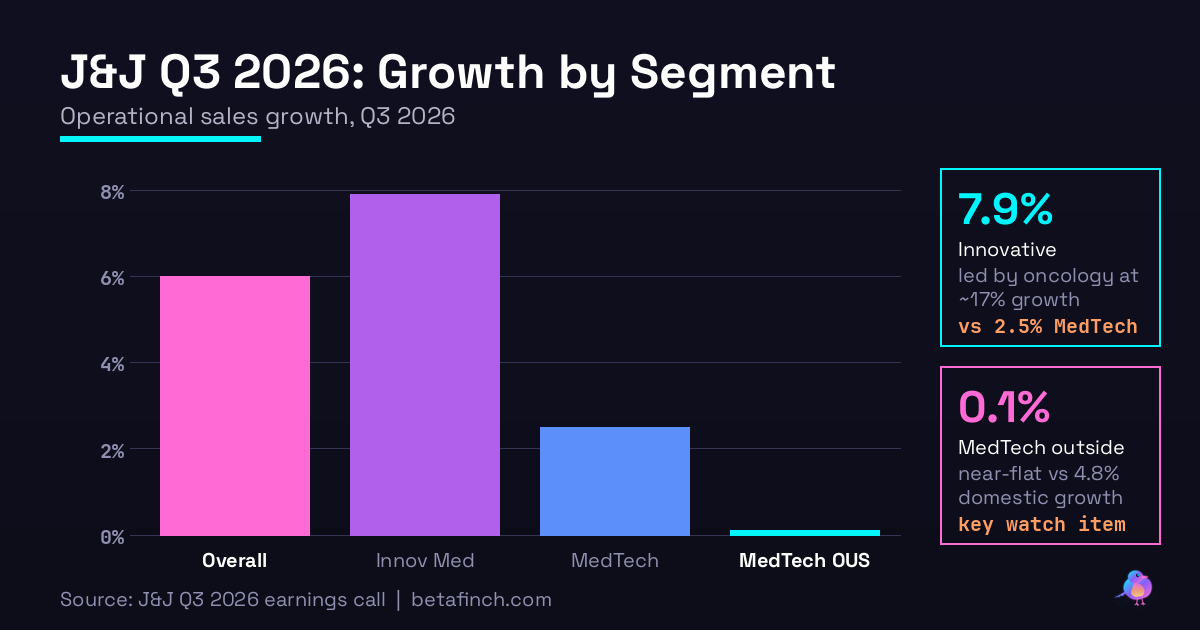
The top-line figure masks a pronounced divergence between J&J's two reporting segments. Innovative Medicine worldwide sales reached $16.8 billion, growing 7.9% operationally, while MedTech posted $8.6 billion, up just 2.5% operationally. The sharper contrast sits in international MedTech, which grew only 0.1% outside the United States, indicating that overseas markets are effectively flat for the device and diagnostics segment. That near-zero international reading carries the most analytical weight of any single number in the quarter.
The two-segment structure has defined J&J since the 2023 Kenvue spinoff, which separated consumer health and left the company as a focused pharma-MedTech entity. The resulting 7.8-percentage-point gap between segment growth rates is the central story of Q3. Pharmaceutical volume is being driven by high-growth oncology and immunology assets with durable market share positions, while MedTech faces procedural and pricing headwinds in international markets that domestic performance only partly offsets.
Oncology as the Primary Growth Engine
Oncology was the primary growth engine within Innovative Medicine, expanding approximately 17% in the quarter, well ahead of the segment's 7.9% overall rate. DARZALEX, the multiple myeloma treatment, grew 15.6%, driven by 5 points of share gains across all lines of therapy, with 10 points of share gain in the frontline setting. Frontline positions are structurally significant: newly diagnosed multiple myeloma represents the largest patient pool, treatment durations are longer than in relapsed or refractory lines, and physicians who establish DARZALEX-based regimens early tend to maintain them absent a compelling clinical reason to switch.
RYBREVANT combined with lazertinib delivered growth of 63.5%, with strong share gains in both first- and second-line non-small cell lung cancer settings. The combination is one of the faster-growing oncology assets in J&J's portfolio as targeted therapy adoption continues expanding among oncologists treating EGFR-mutated patients. Immunology contributed meaningfully as well: Tremfya grew 68.2%, driven by IBD launch momentum, with 4 points of share growth in both ulcerative colitis and Crohn's disease. SPRAVATO, the treatment-resistant depression therapy, expanded 36%, and CAPLYTA delivered 66.1% growth, each benefiting from continued prescriber adoption as clinical familiarity deepens.
MedTech: Bright Spots Against Flat International Performance
Within MedTech, Shockwave Medical grew 17.2%, driven by continued adoption of coronary and peripheral intravascular lithotripsy products across hospital and ambulatory settings. Shockwave's performance reflects sustained procedural penetration in a market where the technology addresses calcified lesions that conventional angioplasty handles poorly. VARIPULSE, J&J's pulsed field ablation platform for atrial fibrillation, surpassed 100,000 patients treated worldwide, a procedural milestone that reflects growing adoption in electrophysiology labs across multiple geographies. These individual bright spots stand out against the segment backdrop, where overall international markets grew only 0.1% operationally and Abiomed, the cardiac assist device franchise, posted a 1.5% decline.
The FDA granted de novo authorization to J&J's OTTAVA robotic surgery platform during the quarter, a regulatory clearance that opens the commercial launch pathway. OTTAVA enters a surgical robotics market where Intuitive Surgical's da Vinci system holds commanding share, and the de novo authorization establishes J&J as a credentialed competitor rather than a development-stage entrant. The commercial rollout timeline, hospital capital approval cycles, and the pace of procedure volume ramp will determine how quickly OTTAVA contributes materially to MedTech revenue. The authorization is a qualifying milestone; the revenue contribution remains a forward variable to track alongside broader healthcare sector earnings trends across the industry.
EPS Decline: One-Time Charges, Not Operating Deterioration
Adjusted diluted EPS of $2.59 represented a 6.8% decline versus Q3 2025. Management attributed the year-over-year pressure to acquisition-related charges from the Firefly Bio and Cell BioMedicines transactions, distinguishing those deal costs from underlying operating performance. Separating one-time items from recurring trajectory is important context here; the headline EPS decline does not reflect a change in J&J's revenue momentum, which remained positive across both segments. The full-year adjusted EPS guidance range of $10.95 to $11.05 implies the charges are largely absorbed rather than recurring into Q4.
Raised Guidance and Key Variables Heading Into Year-End
Johnson & Johnson raised its full-year 2026 revenue guidance to approximately $100.7 billion, representing roughly 6.9% growth at the midpoint. Full-year adjusted EPS guidance was set at $10.95 to $11.05. Reaching $100.7 billion in annual revenue would mark the first time the company has crossed the $100 billion annual threshold, reflecting a decade of portfolio reshaping that includes the Kenvue spinoff and targeted acquisitions in oncology, electrophysiology, and cardiovascular intervention. A guidance raise this late in the fiscal year typically indicates management's confidence in fourth-quarter execution, particularly in the pharmaceutical segment.
Three variables carry the most analytical weight heading into year-end and 2027. MedTech international growth at 0.1% needs to show recovery; without improvement in outside-U.S. markets, the device segment will remain disproportionately dependent on domestic volume, which carries its own procedural cycle exposure. The OTTAVA robotic surgery commercial rollout is the most visible near-term catalyst for MedTech, with hospital capital committee timelines and training program scale the primary gating factors. STELARA biosimilar erosion remains the most consequential structural headwind for Innovative Medicine: as biosimilars expand their formulary positions across commercial and government payers, the pace of STELARA volume erosion will determine how much of that pressure the portfolio's newer growth assets, including RYBREVANT, Tremfya, and DARZALEX, must absorb to maintain segment momentum.
For a full breakdown of the quarter's results, the <a href="/podcasts/JNJ_Q3_2026">J&J Q3 2026 earnings podcast</a> covers segment dynamics, pipeline developments, and management commentary in detail.
Q3 2026 Highlights at a Glance
- Q3 worldwide sales: $25.4 billion, up 6% operationally year over year
- Innovative Medicine: $16.8 billion, +7.9% operational growth
- MedTech: $8.6 billion, +2.5% operational growth; +0.1% outside the U.S.
- Oncology segment: approximately 17% growth, led by DARZALEX (+15.6%) and RYBREVANT (+63.5%)
- Immunology: Tremfya +68.2%, SPRAVATO +36%, CAPLYTA +66.1%
- MedTech highlights: Shockwave +17.2%, VARIPULSE surpassed 100,000 patients treated worldwide
- Adjusted diluted EPS: $2.59, down 6.8%, impacted by Firefly Bio and Cell BioMedicines acquisition charges
- Full-year 2026 guidance: approximately $100.7 billion revenue; $10.95 to $11.05 adjusted EPS