NVIDIA Q2 FY2027 Revenue Breakdown: Data Center, Hyperscale and ACIE Segment Growth
Q2 Revenue Reaches $96B as Data Center Dominates
NVIDIA (NVDA) reported Q2 FY2027 total revenue of $96B, more than doubling year-over-year for the fourth consecutive quarter of accelerating growth. The result continues a trajectory that has seen each successive quarter set a new quarterly record for any semiconductor company. Data center revenue reached $89B in Q2, up 18% quarter-over-quarter, accounting for roughly 93% of consolidated revenue.
The concentration in data center reflects how thoroughly the AI infrastructure build-out has reshaped NVIDIA's revenue mix since fiscal 2024. Gaming, professional visualization, automotive, and OEM segments each contribute, but data center has become the defining business. The 18% sequential gain at $89B represents an absolute dollar increase of approximately $13.5B in a single quarter.
Hyperscale and ACIE: Diverging Growth Rates
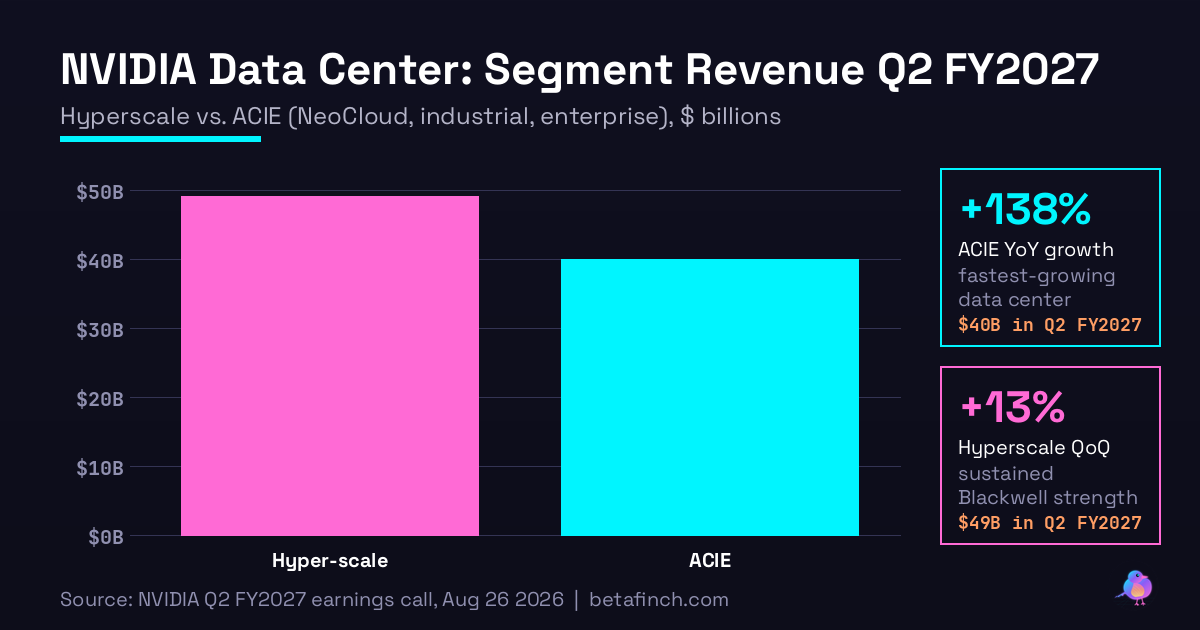
Within data center, NVIDIA reports two customer groups. Hyperscale covers the five largest cloud providers. ACIE encompasses NeoCloud operators, sovereign AI programs, industrial customers, and enterprise accounts. In Q2 FY2027, hyperscale revenue reached $49B, up 13% sequentially. ACIE revenue came in at $40B, up 25% sequentially and 138% year-over-year.
The divergence in growth rates is the central data point of the quarter. ACIE is approaching parity with hyperscale in absolute terms while growing at nearly double the sequential rate. At $40B versus $49B, the gap has narrowed to $9B. If ACIE's 25% sequential pace persists alongside hyperscale growth near 13%, the two buckets could reach rough dollar parity within two to three quarters. That convergence, more than the total segment number, defines where the incremental infrastructure dollar is currently landing.
Key Numbers
Revenue: $96B
Revenue Growth: +100%+
Inside ACIE: NeoCloud, Sovereign AI, and Enterprise
The ACIE label covers three customer types with distinct build timelines and purchasing patterns. NeoCloud partners are independent cloud operators constructing large-scale GPU clusters for AI training and inference services. These operators are expected to exit calendar year 2026 with 8 gigawatts of total installed capacity, up from approximately 3 gigawatts at the end of 2025. That near-tripling of physical capacity within roughly twelve months requires sustained procurement at scale.
Sovereign AI programs form the second component of ACIE. Revenue from this group grew 35% sequentially and more than tripled year-over-year in Q2 FY2027. National AI initiatives across Europe, the Middle East, and Asia-Pacific are purchasing GPU infrastructure to build compute capacity under domestic control. Enterprise and industrial customers, training models on proprietary data or running inference at the edge, contribute the remainder.
The AWS deployment commitment illustrates the overlap between the two customer buckets. Amazon Web Services (AWS) is deploying an additional 2 million GPUs starting Q2 FY2027 through Q2 FY2029, a two-year program that spans hyperscale and adjacent cloud infrastructure categories. The duration and scale of that commitment reflect how capital-intensive the current build cycle has become across the industry.
Revenue Per Gigawatt: The Generational Staircase
Each GPU generation expands not only raw performance but also NVIDIA's revenue per unit of physical capacity. With Hopper-generation hardware, NVIDIA estimated roughly $18B of revenue opportunity per gigawatt of installed capacity. Blackwell raised that figure to approximately $25B per gigawatt. The upcoming Vera Rubin generation is expected to generate approximately $40B per gigawatt.
The progression from $18B to $25B to $40B per gigawatt means that as customers refresh their installed base, the same physical footprint in power draw and floor space generates materially more dollars. For NeoCloud operators scaling from 3 gigawatts to 8 gigawatts on Blackwell, the per-gigawatt figure of $25B implies a capacity-weighted revenue opportunity well above what earlier Hopper deployments supported. A subsequent Vera Rubin refresh would step that revenue density up again without requiring proportional additions to physical infrastructure.
NVIDIA has characterized Vera Rubin as the fastest product ramp in the company's history, a claim consistent with demand signals visible in NeoCloud backlog, sovereign program procurement, and hyperscaler purchasing timelines. Each prior generation transition also set records in its time, but the absolute dollar scale of Vera Rubin's $40B per gigawatt figure compounds the ramp magnitude considerably compared with prior cycles.
Gross Margin and the Q4 Trough
Gross margin held at 75% in Q2 FY2027, flat quarter-over-quarter. NVIDIA guided gross margin to trough in Q4 FY2027 at 71-72%, with recovery expected thereafter. The guided dip reflects Blackwell product mix dynamics during the ramp phase, as new silicon typically carries lower initial margin before yields and supply chain costs normalize.
Q3 FY2027 revenue guidance is $108B, plus or minus 2%. For FY2028, NVIDIA's outlook calls for approximately 70% year-over-year revenue growth. Company commentary framed the FY2028 trajectory as supply-constrained rather than demand-constrained, indicating that production capacity, not customer appetite, is the current binding variable on near-term revenue.
Hyperscaler CapEx and the Forward Context
The macro backdrop for NVIDIA's guidance sits in hyperscaler capital expenditure commitments. Combined CapEx from the top five hyperscalers is expected to reach nearly $800B in 2026 and $1.3T in 2027. Those figures represent a substantial share of total global IT infrastructure investment and flow primarily into compute, networking, and storage procurement for AI workloads.
At those spending levels, NVIDIA's Q3 guidance of $108B and its FY2028 growth target of approximately 70% represent the visible portion of a much larger committed investment cycle. The [NVIDIA Q2 FY2027 earnings podcast](/podcasts/NVDA_Q2_2027) covers segment-level management commentary in full. Additional NVDA earnings context is available in the [semiconductors archive](/groups/semiconductors).
Key Figures from Q2 FY2027
- Total revenue: $96B, more than doubling year-over-year for the fourth consecutive quarter of accelerating growth
- Data center: $89B, +18% quarter-over-quarter
- Hyperscale revenue: $49B, +13% sequentially; ACIE revenue: $40B, +25% sequentially, +138% year-over-year
- NeoCloud installed capacity: approximately 3 GW at end-2025, expected to reach 8 GW by year-end 2026
- Sovereign AI revenue: +35% sequentially, more than tripled year-over-year
- Revenue per gigawatt: $18B (Hopper), $25B (Blackwell), $40B (Vera Rubin)
- Gross margin: 75% in Q2, guided to trough at 71-72% in Q4 FY2027 before recovering
- Q3 FY2027 guidance: $108B, plus or minus 2%; FY2028 growth outlook approximately 70%, supply-constrained
- Top five hyperscaler CapEx: approximately $800B in 2026, $1.3T in 2027
- AWS GPU deployment: 2 million additional GPUs from Q2 FY2027 through Q2 FY2029